Introduction
It is often said that revolutionary innovations are rarely entirely new. Instead, they tend to emerge from the intelligent recombination of existing technologies. Blockchain is a good example: it leverages well-known concepts—such as Merkle trees, cryptography, and distributed ledgers—in a novel configuration that unlocks new possibilities. As the saying goes, “I simply stood on the shoulders of giants.”
This blog explores a similar idea: how digital technologies can allow even the smallest photovoltaic (PV) system owners to participate in carbon credit markets—something traditionally feasible only for large-scale producers.
The Opportunity: Carbon Credits from Small-Scale Solar Generation
Electricity generated by PV systems displaces electricity from the existing grid, where the CO₂-equivalent emissions per kilowatt-hour are typically higher. This difference can be quantified as an emissions reduction and converted into tradable certificates on voluntary carbon markets.
For large renewable energy operators, certifying these reductions is a straightforward process. For small producers, however, the path is far more complicated. The current mechanism of certification excludes 99% of small-scale photovoltaic producers from carbon markets due to prohibitive costs.
Why Small Producers Are Excluded Today
In practice, individual owners of small PV systems almost never certify CO₂ credits. The barriers are significant:
- High certification costs: Formal certification programs require extensive documentation, third-party audits, and administrative effort.
- Low financial return: A typical household in Central Europe produces 4,000–10,000 kWh annually. With a relatively clean electricity mix (approx. 150 g CO₂eq/kWh in Switzerland; 400 g CO₂eq/kWh in Germany), this results in only 0.5–4 tonnes of CO₂ reductions per year.
- Modest revenue potential: At a market price of ~EUR 30 per tonne, a household might earn around EUR 100 annually—far below the cost of a traditional Monitoring, Varlidation and Reporting (MRV) systems that imposes annual costs of approximately € 4,200 per installation (TÜV SÜD, 2023; DNV, 2023)
For a single household, the economics are simply not viable.
A Scalable Solution: Pooled Certification using digital MRV
A promising approach is to adopt a pooling model that enables thousands of small PV owners to certify together. The idea is to establish a standardized, large-scale certification program—ideally above 1000 producers—that spreads fixed costs across all participants.
Under such a model:
- Homeowners join the pool at no cost.
- They assign the management of their carbon credits to the pool operator.
- In return, they receive a small annual remuneration, proportional to the certificates generated by their system.
The key enabler is a low-cost, independent data-collection device that can be installed without interfering with existing hardware or software. There are no installation, maintenance, or operating costs for the producer.
Economic Feasibility at Scale
A pool of 1’000 producers with an average annual generation of 50,000 kWh/a would produce approximately 7,500 tonnes of CO₂eq reductions per year—worth around EUR 200,000/a at current voluntary market prices (Ecosystem Marketplace, 2024)
With certification and operational costs distributed across the entire pool, the model becomes economically sustainable.
Technological Foundation: IoT + Cloud Computing + AI + Blockchain
All required technological components are mature and already deployed in other sectors. A robust system could include:
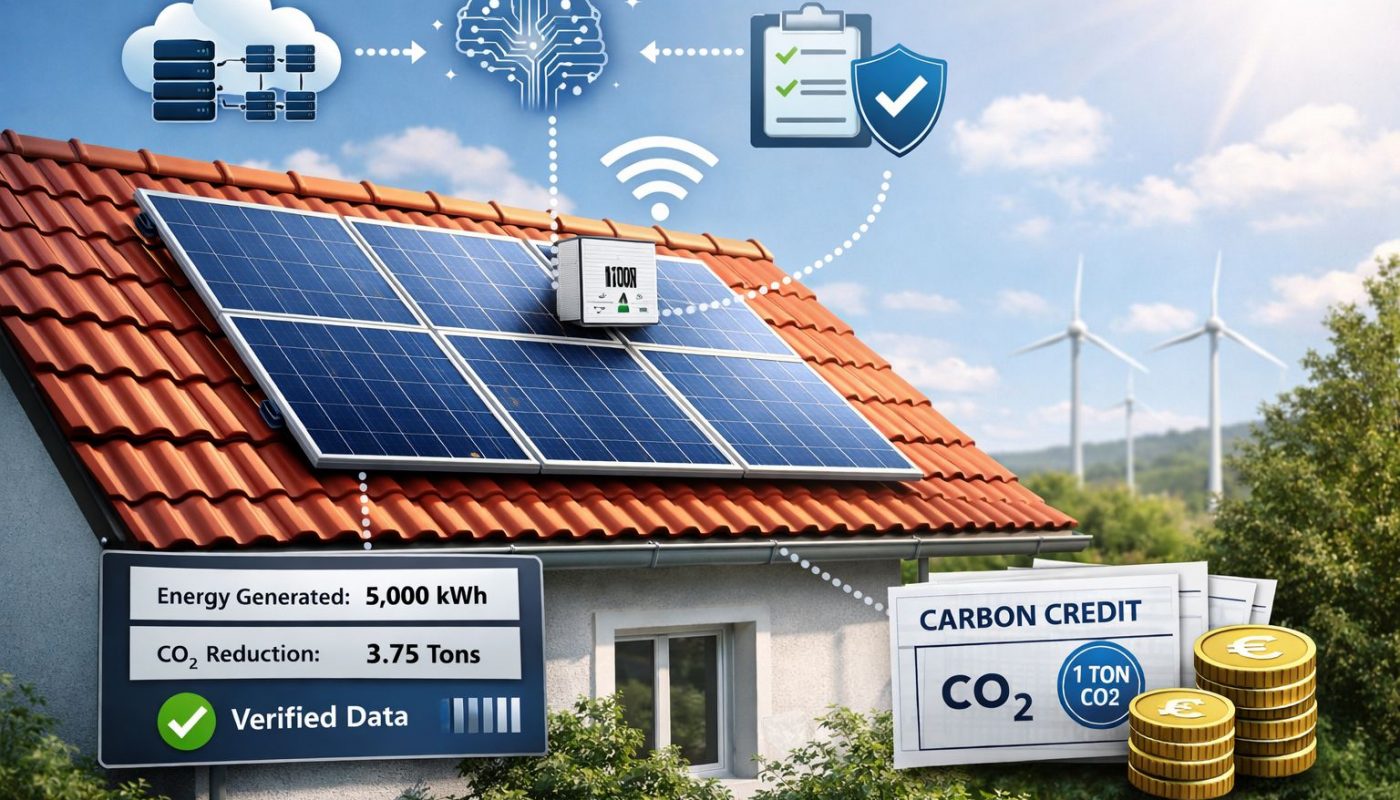
- A programmable smart meter for on-site data collection, connected via Wi-Fi and installed during PV setup—free for the operator.
- Cloud-based data processing using transparent, open-source code verifiable by certification bodies.
- Anti-tampering and anomaly detection mechanisms, combining device-level measures with AI-based monitoring.
- Blockchain-based registration for transparency, decentralization, and traceability of generated credits.
- Independent third-party validation of the entire system, including code, firmware, and monitoring architecture.
The Real Challenge: Market Acceptance and Scalability
The technical elements are not the primary barrier. Instead, the success of this model depends on:
- The willingness of certification bodies to accept a standardized, pooled digital methodology.
- The openness of market participants to credits generated via digital monitoring and reduced manual intervention.
- The interest of PV installation companies in offering such a service.
- The practical integration of smart meters into existing installation processes.
- The realistic potential scale: How many producers can be reached?
These questions define the feasibility of a digital pooling model capable of bringing micro-producers into carbon markets.
References
- TÜV SÜD (2023). Carbon Project Development and Verification Pricing Guide. Link: TÜV SÜD Voluntary Carbon Credit Projects
- Ecosystem Marketplace (2024). State of Voluntary Carbon Markets 2024. Link: State of the Voluntary Carbon Markets 2024 (PDF)