
Discover how you can incorporate life-centered design into your values and what this has to do with mandarins.

The human-centered design methodology encourages designers to develop an empathetic understanding of people’s needs to design relevant solutions. But what is with the needs of our planet? How can we include every organism and life in designing our world?

The range of life

Human-centered design is tackling the importance of fully engaging with the needs of people as the experiencer. However, we are currently faced with the challenge as well as the opportunity to preserve the living on this planet. This complexity needs a new approach to tackle today’s wicked problems.

The focus on one user must change. After all, the idea of a human-centered design seems egocentric and one-sided in its purpose around people. Life-centered design means contributing to all living organisms in a way that not only does no harm but actively helps to survive and thrive.

This thought is inspired by author John Thackara, according to which one does not develop for the life of an individual, but the whole life of every organism and our planet. Everything is interconnected, people are not separate from the planet we all live on, including the major climate systems. Because everything affects everything else in one way or another, which is why there needs to be a shift towards a culture where designers address people as part of the ecosystem rather than the center of everything.

The full picture in mind

Today, we live in an era in which products and systems can communicate with each other, solve problems independently and learn from collected data and its errors. Life-centered design is part of an ecosystem of things. It raises the question of how we can enable our products and services to sustain themselves and help us make better decisions.

After all, design can no longer revolve solely around the product or service to be produced. Nor can it be specifically about the user experience. Design must now evolve to include systems of scale, and we must begin to design the business models of products and services to incorporate environmental impacts and economic externalities such as ecosystem degradation.

Unfortunately, many products are made for single use only and are therefore the very opposite of life-centered design. As an example, a great fitness device that can be used for a variety of exercises could not be included in the product range of a sports shop because the equipment rarely breaks down and therefore does not need to be repaired or replaced. In this case, the retailer could sell the product only once per customer. Instead of celebrating this type of product because of its great design, which combines durability and versatility, it is rejected for reasons of profitability.

This shows that our current economic model is designed for consumption. Companies are encouraged to produce as many versions of a product as cheaply and as often as possible. It requires a change in thinking and the intention to design something that gets by with as little waste and disorder as possible.

“If only nature would find a way to cover these mandarins so we didn’t need to waste so much plastic on them.”
– Tweet by Nathalie Gordon 

In grocery stores we find a similar phenomenon. Just recently a Twitter-Post went viral because a customer uploaded a picture from a famous food-supplier, showing a pre-peeled mandarin in a plastic packaging. An alarming indicator that our society has become too convenient as mandarins are already in the packaging, namely the most perfect packaging in the world – their skin.

Instead of an additive approach, life-centered design explores how it can design as good as nature to create products and services that complement the ecosystem in which we live, rather than harming the environment.

We as consumers should rethink what we buy and consume, but a large part of it is also on the shoulders of organizations. However, the will to change for the better must be there and organizations must recognize the opportunities for a business that works with the environment in mind.

On the example of LOOP™

Nine brands of the consumer goods company Unilever have introduced reusable packaging solutions. They are being tested on LOOP™, a global waste-free purchasing system launched a year ago. The system unites major brands and retailers with the idea of moving from a disposable model, where packaging is thrown away or recycled after use, to a circular model, where packaging is reused, and all product waste is either recycled or used in a new product cycle.

Tackling the sweet spot

If you are now wondering where to start developing life-centered goods, familiarize yourself with the innovation triangle, which can be ideally integrated into your strategy.

Similar to human-centered design, the innovation triangle can also be applied to life-centered design. In this context, we simply need to redefine what we mean by this. It is about how the ideal intersection of desirability, feasibility and viability changes and how organizations respond to it. Design must be extremely sensitive to trends in ecosystems and how they affect the triangle. This in mind, the following features are essential.

Desirability

Desirability tests whether your innovation addresses the right customer problem and accurately represents what the customer needs.

Feasibility

The second part of the triangle, feasibility, assesses whether your innovation will enhance your business and build on the strengths of your current operational capabilities.

To return to the example above, Unilever is addressing the issue of feasibility with its system LOOP™ by introducing reusable, refillable packaging to help reduce waste.

Viability

Viability tests your value chain for a long-term sustainable business model. Viable means that everything is highly desirable and feasible, but also whether you can actually make money from it.

Unilever is investing in new business models around refillable products and services that are economically viable. According to their research, they have found out that 30% of consumers buy brands because of their social and environmental impact and more than 50% are more likely to buy products that are produced sustainably.

Checklist: 6 points to consider

Take note of the following points to integrate a life-centered design approach in your organization.

1. Redefinition

Redefine the desirability, feasibility and viability of your work and consider how your offer can be made regenerative through design. Use design as a central tool to focus on transformation and the purpose of innovation.

2. Circulation

Explore new ways to create sustainable, resilient and long-lasting values. The processes of creation and disassembly of your product’s next life affects the environment and must be considered as part of the design.

3. Simplicity

The key is often simplicity. By making things durable, by keeping it minimal and without clutter, unobtrusive and pure in its intention, design can act intelligently within an existing ecosystem. Consumers should be able to use a simple return service to put as many used products as possible back into circulation. After all, if this is simple, consumer behavior can be changed permanently.

4. Collaboration

New business models must be designed to achieve the necessary changes on a large scale. Collaborate with partners to gain new insights into product development and the use and disposal of packaging.

5. Transparency

Offer customers insights and incentives about your products. Make clear that you consider natural, political and social ecosystems as equal. Show that life-centered design is your new standard, not just a project.

6. Improvement

Iteration is your friend when you integrate the innovation triangle into your process. Due to a constant gain in knowledge, many needs and expectations only become apparent in the course of development, whereby the product life cycle needs to be constantly optimized.

The foundation of a lived culture 

Although life-centered design is seen as another trend of today, it is in fact a solution for current needs. Compared to the human-centered design approach, which has been a mantra for the entire industry, life-centered design represents a significant development.

Life-centered design helps to promote a way of thinking that considers not only the end user, but all users and parties involved in production, use and disposal. To incorporate life-centered design into your values, your organization needs to look beyond the direct or indirect effects of their design activities on us humans and work out solutions with the ulterior motive on the overall system to which we humans belong.

Through continuous improvement, by responsibly shaping not only the life of a product, but also its reorientation or disposal, we come closer to designing solutions that truly work for life and not ultimately against life. Solutions that are invaluable to people, that give businesses a competitive edge and are renewable for our world.

For this reason, update your design skills with system thinking. Collaborate with others and actively design in systems that encourage people to reduce their resource consumption. We all know the expression “less is more”, but we genuinely need less things for the sake of things and more things that benefit everyone.


Sources

Cassie Robinson. (2018). Beyond human-centred design, to?
Retrieved from: https://medium.com/@cassierobinson/beyond-human-centred-design-to-501a994f3123

Fjord. Life-centered design.
Retrieved from: https://trends.fjordnet.com/trends/life-centered-design

Johnathyn Owens. (2019). 10 Principles of Life Centered Design.
Retrieved from: https://medium.com/the-sentient-files/10-principles-of-life-centered-design-3c5f543414f3

Kristan Orton. (2017). Desirability, Feasibility, Viability: The Sweet Spot for Innovation. Retrieved from: https://medium.com/innovation-sweet-spot/desirability-feasibility-viability-the-sweet-spot-for-innovation-d7946de2183c

Unilever. (2019). We’re introducing reusable, refillable packaging to help cut waste.
Retrieved from: https://www.unilever.com/news/news-and-features/Feature-article/2019/we-are-introducing-reusable-refillable-packaging-to-help-cut-waste.html

Frank Van De Ven. (Image). (2018). The three-way design thinking model.
Retrieved from: https://uxdesign.cc/the-brand-the-forgotten-child-in-design-thinking-74bc54ee4abe

Featured Image: Andrea Rico. Retrieved from: https://unsplash.com/photos/n-bUCycGItg

 

How the secret powers of A/B Testing can improve your future online business.


Have you ever scrolled through a famous digital platform such as Google, Youtube or Instagram and wondered how these companies optimize the design of their product experience for the user? How do they make these websites instantly catch the user’s attention, or make sure that the browsing experience is as smooth as possible and the information just where you want it to be? When visiting these websites, one often browses through them without noticing the details of their design, as if browsing them is as natural and unconscious as the feeling of breathing. What is the secret optimization formula behind the design processes of these websites? Indeed there is a secret, just that the secret is already commonly known and applied by the world’s largest and most successful tech businesses such as Google, IBM, Microsoft and Spotify. In this article, we will take a glimpse into A/B testing, the secret formula, and how this framework for digital experimentation can help you to radically improve your online business.


Defining A/B Testing

Now that we have caught your attention, we can slowly introduce you to what A/B testing is. A/B testing is the creation of variations of a website, which get tested in a testing environment with the user. The “A” in A/B testing represents the original version, the control group, while the “B”, represents the treatment group, the variations that are put against the original’s performance. The treatment group “B” can be further expanded to “C, D, E, F… n”, and so on, further adding to the number of variations that are put against the control group and each other. The experiment can be carried out in a closed environment with a selected group of users or in the public domain of a live website. In parallel to the execution of the experiment, performance indicators, such as conversion rates, interaction rates, numbers of visitors, etc. are being recorded. These indicators help to select the variation that performs the best against the control. At the end of the A/B test, the best performing variation is then made the default and the testing cycle starts over again. This is how A/B testing works on a basic level.


A Brief History of A/B Testing

But before we jump straight into the details of A/B testing, let’s quickly go through the brief history of A/B testing and how it evolved into the current method that is widely used in tech today. Going back in time the story begins in the year 2000, with Google engineers experimenting with variations in the design of Google’s search result page. The goal was to find out the optimal amount of search results displayed on a single page. After the experimentation, they found out that displaying 10 search results led to the most amount of desired user interaction. Ever since then 10 results per page remained as the answer to their design question. In the following years, other tech companies such as Amazon, MSN and Bing followed by experimenting where and how to display advertisements throughout their platforms. In Bing’s case, the selection of the winning variation in the A/B test increased the revenue drastically by 12%. Today, each of these companies run tens of thousands of A/B tests annually, making it the strongest tool for increasing a website’s performance.


Three Best Practices in A/B Testing

So you might wonder how this can be applied to your business’ website? This is why in the following section we will present you three essential best practices in A/B testing that are easily applicable and will give you real-world cases and benefits of the A/B testing method.


1. Select what you want to test, before you test.

Before you start creating random variations of your website, you should consider what you want to test in the first place. What is the purpose of your A/B test? Is it to test an ad? The size of an ad on your website? The content of the ad or its positioning on the website? Those are the questions that have to be answered and kept in mind when running an A/B test. For what was not measured during the test, can’t be proven after the test. To give you an idea of how you can apply that, we will look into an example where we take the positioning of the ad as the element we want to look at in our A/B test. In this case, we will choose the number of users clicking on the ad’s link as the unit of measurement of desired performance. Now we create a variation, where the ad is displayed inside the content section of the website, while we keep the original, where the ad is at the beginning for controlling purposes. After assigning the testing variations to two user groups, we can see how the different positioning of the Ad affects the outcome in performance. if there is a significant difference in performance, we apply the superior variant for the ad positioning. Now we have improved upon the selected aspect of the website via A/B testing by conducting a specific test.


2. Running many tests over a long period of time.

The easiest way to increase the potential of A/B testing is to increase the numbers of tests that run simultaneously. This allows you to have higher odds of getting a successful test outcome as you diversify your bets. For example, when comparing an A/B test consisting of only one variation from the original to an A/B test that has a hundred variations, it becomes very clear which of these two will lead to the closest point to the maximum performing outcome. In another perspective, the chances of getting even a worse performing result in the test consisting of only one variation are also significantly higher, as all the bets are being put on one trial. Furthermore, the tests can be distributed and conducted throughout a longer period of time, of let’s say a month instead of just a single day, to see how different variations in the A/B test perform over a time period that involves many user sessions. Applying this method will help you to mitigate the effects of “novelty”, in which the involved users will often show an initial heightened interest and level of interaction with a new tested feature or element that then decays over time. Thus, running the test over a long period of time, while also running many of them allows you to increase the performance of your A/B tests while also gaining more truthful data from it.


3. Building an experimentation culture

The last vital decision and endeavour to make when implementing A/B testing as part of any business, is to take a closer look at the current culture. Do employees shy away from risks and uncertainty? Are there any signs of blame games going on whenever a project fails ? 

These are just two of the common signs that your organization may not be able to fully embrace a culture where testing and experimentation is the norm. This kind of situation is normal in larger companies, since usually a few cultures end up being predominant over the entire company. For example, a company focused on rather simple and repetitive tasks as its core business, such as a sales-driven organisation, may apply the tolerance of failure established in the core business to other functions of the business, such as R&D. Therefore, building and maintaining a suited company culture – especially in the part of the business which will be mainly tasked with the testing – is key. An environment which facilitates testing and data-driven decisions are the basis for any course of action needs to be established. This can be done by normalising frequent tests and making sure that leaders are role models for this kind of culture. Furthermore, the required infrastructure and decision power need to be put in place. This enables teams to perform and really showcase some of the key strengths of A/B testing. Often this means flying under the radar for some time, making it easier for a certain culture of experimentation to coexist in a company with otherwise completely different norms. In order to truly capitalize on the benefits of A/B testing and experimentation, in the long term it is often easier to embed it at the core of the organization.


Making the First Step

Having said that all, how can you capitalize on this knowledge? It all seems to be a lot and you probably ask yourself: where do I start with all of this? A/B testing is a methodology that requires technical infrastructure that allows you to automatically redirect incoming users towards the desired test variations. But luckily there are many easy-to-implement solutions already existing out there, such as the tools Google Analytics and Google Optimizer. These tools allow you to implement the technical basics for your A/B testing endeavours. The use of Google Analytics allows you to collect quantitative customer data, such as the number of visitors, conversion rate, interaction and use of tools, etc., while Google Optimizer allows you to display A/B test variations on your live website. Thus the combination of the two tools allows you to run A/B tests on your website without the need to develop and implement every technical detail on your own. This saves not only precious time, but also money that would have been spent on additional software developers. But of course, if your business can afford the full financial investment of an A/B testing infrastructure for your website, it would make more sense to choose a custom solution that fits your business’ needs.


Three Pitfalls in A/B Testing

Once you have taken the first steps and established the infrastructure, culture and the expectations for your testing endeavours, there are a few major pitfalls that might prevent you from getting more out of it. In the following part, we have highlighted some of the most common mistakes which you should avoid, as well as how you can deal with them.


1. Averaging out valuable data

While it may be tempting to come up with decisions when looking at the outcome of a test across all user segments, this overview often simplifies the data. Amidst these simplified dashboards which aim to give you a brief overview, it’s easy to forget that behind this consolidated data, there is a diverse set of users making up a population of data points, each acting in their own unique and different way.

Thus, it is useful to predefine certain user segments when running a large scale test. This empowers you to look beyond the average of the data set and enables you to segment users in regards to their geographical location, behaviour, past engagement, or even their previous decisions in other A/B tests. In a second step, targeting a predefined segment of users enables you to test innovations which aim at encouraging a defined set of behaviours for a user segment.

An example for this was when employees at Amazon recognized that a certain type of users would often purchase products at unusual hours during the day. By narrowing down testing to target only those users, they were able to find that those users would respond to an Ad placement on an external website only if it corresponded roughly with their usual purchase time. This not only made timed ads extremely effective for these users, but also meant that including them in testing environments with average users would have likely presented them as outliers, and the data is ignored.

Therefore, segmentation creates a positive feedback loop in which by testing more, you will be able to segment the user base more, which enables you to run highly segmented experiments which then can help you to narrow down the user base even further. 

With that in mind, you should still not try to get more out of the data than there really is. Statistical outliers are common among all kinds of tests, and there is no exception when it comes to A/B testing. Don’t get caught up trying to follow individual users who represent extreme outliers, instead find a good balance.


2. Not considering users as part of a community

A second common pitfall of A/B testing is to consider each user as a unique entity and to forget that some actions may have a network effect and influence the behaviour of many other users. Changes that include users being encouraged to interact with other users in different ways, often also affect the entire system in which these users operate. An experiment which encourages certain behaviour such as a user sending a message to another user on their birthday might also influence the users not directly affected by the experiment, in this case, the user receiving congratulations for their birthday. One common solution to this issue is to use A/B network testing. In order to get the full picture of the implications of a change, in an A/B network, isolated user groups represent control and test cases. This helps you to understand the systemic impact of any changes, and see the downstream effects of certain changes. Simply put, it helps you see the butterfly effect following a butterfly’s wing flaps.


3. Lack of patience and strategic consideration

Just as it may take many interactions to create a user behaviour pattern, it may also take a while to change it. That’s why short term testing can seldom reveal the real effects the change may have on the user in the long run. Furthermore, the effects may differ substantially depending on the exposure a user has on a certain treatment.  It is therefore advised to keep tests running until user behaviour has stabilised before drawing any conclusions. Another approach to show the long term systemic effects of changes, is to run time series experiments. This means exposing a large segment of the market to a certain change for a longer timeframe, aimed at showing the long term effects of certain treatments against the control.

It is important to note that many experimentation projects are not fully able to take off because too much is expected too soon. While simple tests can be established with relative ease, it may take many iterations and an extended duration to establish a solid testing routine and the necessary infrastructure to support it.


Key Takeaways

Once you have the necessary technical infrastructure, it is an easy step to make towards running the A/B test. Just keep in mind the three best practices and three pitfalls that will guide you towards your end goal of increasing your website’s performance, whether it is about improving the user experience, or gaining more clicks on advertisements.  Always be selective of what you want to test, and keep tests running as frequently as possible, and for extended durations. Build a culture that allows for frequent tests, and which embraces experimentation as a key tool for optimization. And while you are building on these best practises, always keep in mind that averaging out data means missing out on valuable insights. Segment your user base, and always keep in mind that there may be an entire network of users affected by just one change. Lastly, always keep in mind that testing is a long term effort and that you should always set the expectations about this straight. Testing is about adopting a mindset of continuous improvement, and doing so will greatly empower you to make the right decisions.


Sources

Stefan Thomke. (2020). Building a Culture of Experimentation
https://hbr.org/2020/03/productive-innovation#building-a-culture-of-experimentation

Iavor Bojinov, Guillaume Saint-Jacques and Martin Tingley. (2020). Avoid the Pitfalls of A/B Testing
https://hbr.org/2020/03/productive-innovation#avoid-the-pitfalls-of-a-b-testing

Daniel McGinn. (2020). The Power of These Techniques Is Only Getting Stronger
https://hbr.org/2020/03/productive-innovation#the-power-of-these-techniques-is-only-getting-stronger

Jessie Chen. (2016). How Netflix does A/B Testing Jessie Chen
https://uxdesign.cc/how-netflix-does-a-b-testing-87df9f9bf57c

Amy Gallo. (2017). A Refresher on A/B Testing
https://hbr.org/2017/06/a-refresher-on-ab-testing

Stephen Courtney. (2019). What is AB Testing?
https://www.convertize.com/what-is-ab-testing/

Wikipedia Article. A/B testing
https://en.wikipedia.org/wiki/A/B_testing

The Tsunami of Colourism in West Africa

Image: Bettina Tianah

Introduction

Skin bleaching has become a global phenomenon. But the reason why I am focusing in West Africa is because of the health and financial implications it has in West Africa, as equally important to also discuss remedies for the practice. West Africa is a place where people live on less than a dollar a day, some families can barely afford a meal. A report published by WHO in 2011 shows that skin bleaching products are reportedly the fourth most sought-after household item by African women, alongside essentials like soap, milk, etc. (Stears Business, 2018). Furthermore, a study which was conducted in Senegal, a neighboring country to my country The Gambia, implies that the use of lighting creams is a common practice. The women who participated in the study expressed that they wanted to obtain the so-called ”teint clair” meaning to achieve lighter skin appearance, which is considered elegant. The article also mentioned previous studies that were done in other parts of African countries by various researchers, the data gathered shows the similarities of the practices in other countries such as Kenya, Gambia, Mali where 25% of the women use bleaching creams, Togo 25% and Nigeria 75% which are very alarming rates. (Giudice & Yves, 2002)

Many of the bleaching and lightening products used in West Africa, ranging from creams, soaps, pills and injections, all contain harmful ingredients that are sometimes not even listed on the packaging, such as mercury, high-dose steroids and hydroquinone. Research has shown that these ingredients can cause kidney failure and other illnesses. Further research has identified mechanisms by which hydro-quinone exposure from skin bleaching products could cause psychosocial health, brain damage in fetuses and cancer. (Benn, et al., 2019). Knowing how dangerous these products are why do we want to change ourselves at the expense of our health? I assume that, we were brainwashed to make us feel that we are never good enough by being dark skin. Nevertheless, we have options and solutions to bring an end to the practice and to put an end to the trading of bleaching creams.

Firstly, involving designers, lawmakers, and social media campaigners should be the first step,  anyone who can influence, can make an impact. We should use the powers of design to educate the public about the dangers of the practice, and the medical effects it has on our health, awareness campaigns on the issue needs to be done starting from the bottom up, which is from very young girls to adult women since the older generation had already been brainwash so much that skin bleaching had been integrated into our culture where it has found a home. We should start to work on re-education that stresses changing the mindset and mentality of the people, especially the children to accept their skin and to show them that having dark skin is not a bad thing, our differences are what make us unique. Children’s books and cartoons with characters which looks like the typical West African child should be designed. Programs that enlighten children about the dangers of skin bleaching should be introduced in the school system and also to teach the children about loving and taking pride in themselves. Lastly, lawmakers should introduce higher penalties and fines for the importation and sales of bleaching creams. Moreover, strict controls should be done when goods are getting in the countries, anyone who is found importing bleaching creams should be given longer jail sentences.

Is it greed or has design actually failed us?

To uncover the background of the complexity of the issue, I conducted an extensive research which confirms that large multinational corporations are the major players in the industry, they spend tremendous sums on research and development, and much more on marketing and advertising strategically tailored for African consumers. Furthermore, they hire design experts that are good at creating appealing images and messages which make light skin fashionable, this indirectly portrays blackness with primitiveness and lack of civilization, just for a motive driven by economic greed. ( Glenn 2008, as cited in Jean Michel Massing 1995, 180) argues that advertisements which are design to brainwashed people of colored had been seen dating back to 1930, when a French poster for “Dirtoff” showed a drawing of an African man washing his hands with soap, which then became white, and the declaration was ” Le Savon Dirtoff me blanchit” meaning the Dirtoff soap whitens me. Such dramatic messages showing the black person losing his or her color by using cleaning products has always existed, so the reasons why West Africans are not accepting their skin color is deeper than our subconscious mind. This is because design is a very powerful tool that plays a huge role in influencing the mentality and lifestyle of society, be it in the form of a campaign, images or products. So, the notion of West Africans accepting black pride will not favor the producers of bleaching products, they will do anything to see the business flourish.

My traumatic experience

When I was younger, I had dolls that were white, slender with silky blond hair, which was the opposite of how I looked. As an African child I had different features which are dark skin and afro-kinky hair. And I didn’t know why I couldn’t look like those dolls. I remember asking my mum that if I wash myself with bleach will my skin peel and look like my doll? All I wanted was to look like those dolls. Thinking back, I believe that our experiences as children can influence how we view and perceive the world as we grow older. Judging from my experience as a teenager, I had everything that I wanted. The necessities which were problems for the average teenage girl like food and clothes were not the issue for me. But there was one thing which was missing inside of me, I didn’t know what it was. But one thing I knew was that I hated being black with every fiber in my body. So, I started bleaching my skin, and did so for many years. I wanted to look European. I used to think that being white was extremely beautiful, but today I would rather be two shades darker than a shade lighter.

Psychosocial Motivation

Why are skin bleaching creams continuously raping generations of young women who are entangled in a mentality where there is a sense of importance played on being lighter, how sad could it get when the dark skin woman is no longer deemed beautiful even in the place she calls home when we are part of the continent where more than 76.4% of the population is black. Is the reason why people don’t accept themselves beyond aesthetics?

There is also the psychology of white people tanning their skin to get darker and risking skin cancer along the way whiles black people are bleaching their skin to look whiter and risking their health. The other day, I spoke to a European friend who said that on many occasions she was being told that she was too pale and she should get a tan or apply fake tanning creams, but she didn’t want to do it, hence that’s how she was born and she is happy with her skin, but the constant reminder of her whiteness from people make her feel embarrassed. Should she conform to society’s standard of beauty? Which is what we see on the media, defined as tall, slender and tanned.  Why should we run away from who we are?  We have become so dilutional to the extent that colorism is still a topic in this day and age. Our skin color shouldn’t define what the standard of beauty is. We are all different and special in our way. Moreover, if we want to fight this epidemic, we need to be comfortable with our skin and define beauty by ourselves.

Imagine being ashamed of your skin color

I  met a friend whom I  had a lengthy conversation with, we haven’t seen each other for years, but to my dismay, I didn’t even recognize her when we met, because she changed her skin beyond recognition, she was so light that the veins beneath her skin were visible. I asked her what was the reason of this drastic transformation, and her reply was not surprising, because growing up I have heard the same reasons thousands of times, which was having a lighter skin makes her have access to the privileges in life, like easy access to economic and social status. Moreover, most men have the perception that the lighter a woman is the more beautiful she is, so women who are in the hope of getting married turn to bleaching creams because they believe it gives them a higher chance of getting married.

To conclude, It’s time that we take matters into our hands and it should be done now! Making a change is never easy, but we should work hard to stop the powerful economic forces that are creating the yearning for lightness at the expense of our health. The continent has been exploited for decades, so skin bleaching issues should be treated as a national emergency for every country. We should work on changing the mentality of the people with regards to skin bleaching, it will be difficult, but the conversation about beauty and colorism needs to be open.


Refrerences

Giudice, P. D., & Yves, P. (2002). The widespread use of skin lightening creams in Senegal: a persistent public health problem in West Africa. International Journal of Dermatology41(2), 69–72.

Glenn, E. N. (2008). Yearning for Lightness. Gender & Society22(3), 281–302.

Rao, P. (2019, April). Paying a high price for skin bleaching | https://www.un.org/africarenewal/magazine/april-2019-july-2019/paying-high-price-skin-bleaching


Using a Design Solution to Bring Gender Equality to Iran

For many young woman and girls who were born in the Middle East, their man is the owner of their life and their future. Changing this attitude and bringing about gender equality to give girls the ability to decide their marital status, job status and place of residence is no simple task.

In Iran, based on the constitution of the Islamic Republic of Iran, girls cannot get married without their father’s official consent. Moreover, according to official statistics, forced marriage is usually applied by the individual’s parents and guardians. Some factors and reasons behind forced marriage include designating a special person to marry a child because of the parents’ self-interest, rising age of marriage, expediency of marriage, as well as poverty and the need for financial security. Moreover, in 5.5% of Iranian marriages, the brides are below age 15 and forced by their fathers to marry older men (ISNA News Agency, 2018). After marriage, based on the constitution, woman still cannot decide their future. Indeed, the husband is the owner of the wife. Therefore, a woman can work or leave the country of her residence only with her husband’s official consent. These conditions violate the gender equality for 83 million people in Iran (Tasnim, 2019)

Adapting the constitution of the Islamic Republic of Iran and informing people about their right and gender equality, and also changing their mindset about family ownership can be the way to turn this catastrophic situation around. But what does the path of bringing gender equality in Iran looks like? And who should be leading to change?

The Sustainable Development Goals (SDGs)

The Sustainable Development Goals (SDGs) were developed at the United Nations Conference on Sustainable Development in Rio de Janeiro in 2012. The objective was to produce a set of universal goals that meet the urgent environmental, political and economic challenges facing our world. The 2030 Agenda for Sustainable Development, adopted by all United Nations Member States in 2015, provides a shared blueprint for peace and prosperity for people and the planet, now and into the future. At its heart are the 17 Sustainable Development Goals, which are an urgent call for action by all countries – developed and developing – in a global partnership. They recognize that ending poverty and other deprivations must go hand-in-hand with strategies that improve health and education, reduce inequality, and spur economic growth – all while tackling climate change and working to preserve our oceans and forests. (SDGs, n.d.)

The fifth Sustainable Development Goals 2030 is Gender Equality. Based on this goal “ending all discrimination against women and girls is not only a basic human right, it’s crucial for sustainable future; it’s proven that empowering women and girls helps economic growth and development.”Gender equality goal aims to end all forms of discrimination against all women and girls. Furthermore, it has targeted on eliminating all harmful practices, such as child, early and forced marriage. Moreover, gender equality ensures women’s full and effective participation and equal opportunities for leadership at all levels of decision-making in political, economic and public life. (SDGs, n.d.)

Due to the problems that have existed concerning gender inequality in Iran and on the other hand “Gender Equality” as one of the Sustainable Development Goals, it seems that we have found a concrete way to alter or at least improve the gender inequality situation of in Iran.

Applying the fifth goal of SDGs in Iran

Implementing gender equality declaration and Improving it has many positive impacts on individuals and also on the society at large. To change the current situation of Iranian woman and achieve gender equality targets in Iran we have the world’s Sustainable Development plan. Furthermore, we need the contribution of different parties in Iran to achieve the goal. Indeed, everyone is needed to reach these ambitious targets. The creativity, know-how, technology and financial resources from all of society is necessary to achieve the SDGs in every context. With a focus on the gender equality goal, if SDGs would have been applied in Iran, we achieve many benefits. For instance, the achievement of equality between women and men as partners cause to beneficiaries of development, human rights, humanitarian action and peace, security and mental well-being.

By looking at the Sustainable Development plan as a universal call, its importance, the benefits of it and its results on the various nations, we can be confident that implementing and achieving this plan’s targets will help Iranian people especially women. Furthermore, by striving to address the identified gaps in gender inequality, Iran would have been focused on issues like improving women and youth participation in decision making as well as creating equal employment opportunities for all Iranians. But how does Iran’s contribution to fulfilling its commitment to gender equality plan looks like? Have they been successful so far?

There is a problem 

In September 2015, the UN General Assembly presented the 2030 Agenda for Sustainable Development to 245 states including Iran. Based on the document all of the nations which have participated in this program must ensure inclusive and quality education for all and promote lifelong learning for everyone, regardless of gender, ethnicity or age, by the year 2030. Indeed, education on gender equality and human rights is also one of the educational topics of the 2030 Agenda for Sustainable Development. On September 2015, Iran president accepted to join this universal call and adapt changes in the educational system. (Alipour, 2018).

However, after that leader of the Islamic Revolution Ayatollah Seyed Ali Khamenei strongly criticized the cabinet’s adoption of the UN-devised global education agenda – saying documents founded on “corrupt and devastating Western lifestyle” are unacceptable in Islamic Iran. Furthermore, he states that “This is the Islamic Republic of Iran, and in this country, Islam and the Quran are the base. It is not a place for infiltration of the flawed, devastating and corrupt Western lifestyle.” Moreover, he blamed the Supreme Council of the Cultural Revolution for careless handling of this case so that the Leader himself now has to get involved and oppose it. Consequently, moving toward quality education and lifelong learning which has to be led to achieve not only gender equality, but also other targets have so far neither been approved by the Supreme Council of Cultural Revolution nor become law. (Alipour, 2018).

The government in Iran does not want to address the problem of gender inequality in society and woman life. As I mentioned at the beginning the path of bringing gender equality in Iran is no simple task and Iran have not been successful in this way so far. Who should be leading to change and who is responsible now that we are disappointed with the performance of the Iranian government in the path of bringing gender equality in Iran? what can be a design solution to unravel this concrete issue?

Design a Solution

We have seen that there is a problem of gender inequality in Iran and that the government does not want to contribute to solving this problem. We therefore need a plan that does not require government assistance. To help people in this way, we need a plan to educate them about human rights, gender equality, the benefits of woman empowerment and change their mindset. Moreover, we must inform people about the importance of the right to choose and to be elected and its life-long benefits. Additionally, in the age of digitalization, one of the best tools to inform people and educate them about a topic is social media. In short, educating Iranian people through social media is the most concrete solution meanwhile.

Currently, there are many online articles, case studies and books about gender equality and human rights on the Internet. However, the content of these sources can be useful and understandable mostly for educated people. Moreover, most of them are not Farsi. Consequently, to educate Iranian people we need to produce content about gender equality, tailored to different people’s generation in Iran and also in their language.

The first step to produce educational content would be finding reliable resources and literature which are mostly related to gender equality. After that, we need to translate them to Farsi and cluster the gathered information. Moreover, it required to put inputs in different frames which each of them is appropriate for teenagers, young people, parents and old generation. The next step is to record the collected content in the most influential way such as video, picture, podcast or other visualization formats. Afterwards, the produced content can be released on the Internet and the most accessible media in Iran such as Instagram. Furthermore, it is essential to keep the content updated and motivate people to keep their learning contributions. All in all, this way of education can help Iranian women to know their rights and ask for it. Moreover, Iranian men might reconsider their attitudes and give the right of decision making to the woman regardless of the Islamic constitution in the country.

Sources:

Alipour, Z. (2018, April 11). The teaching of gender equality sparks infighting in Iran. Retrieved March 17, 2020, from https://www.al-monitor.com/pulse/originals/2017/06/iran-unesco-2030-education-plan-rouhani-criticism.html

ISNA News Agency. (2018, December 29). اینفوگرافی / آمار ازدواج کودکان در ایران. Retrieved March 17, 2020, from https://www.isna.ir/news/97100804278/اینفوگرافی-آمار-ازدواج-کودکان-در-ایران

SDGs .:. Sustainable Development Knowledge Platform. (n.d.). Retrieved March 17, 2020, from https://sustainabledevelopment.un.org/sdgs

Tasnim. (2019, June 15). اعلام “وضعیت قرمز” ازدواج و طلاق در کشور جداول آماری- اخبار اجتماعی – اخبار تسنیم. Retrieved March 17, 2020, from https://www.tasnimnews.com/fa/news/1398/03/25/2031804/اعلام-وضعیت-قرمز-ازدواج-و-طلاق-در-کشور-جداول-آماری

Photo by Tim Mossholder on Unsplash

4 Steps you should take to implement Design Management in your Local Organisation

Image: Via dezeen.com, design by NotOnSunday agency.

Most likely you are participating in a local organisation or club when you are not at school or work. This local organisation could be a sports club, political organisation, scout association, hobby related group and so on. These organisations are often voluntary and do not pay their members any money. The participants get involved because of their interest and passion for the cause. Within these organisations, many different people from different backgrounds come together. This leads to an interesting mix of skills and characters, however it is often the case that within the organisation no member has a background in design or design management. Which is difficult, since the organisation could have a lot of design problems or areas where creative problem solving is needed. The solution for these organisations is to outsource everything related to design, for example getting a graphic designer to create the logo or a web designer to create a website. Therefore, the optimal solution would be to have a design manager in the organisation or at least try to implement design management in the organisation. You do not know how? Well, here are 4 steps you should take to implement design management in your local organisation.


Step 1: Analyse the Status Quo

If you are eager to change certain characteristics of your organisation, do it, but make sure everyone agrees with your plan. Organisations like these can often be old and therefore may not be open for a change. Speak to the president of the organisation or when you are the president speak to your members. It is important that everyone is keen on having a change in the organisation, otherwise you will find yourself struggling in the implementation of the change. Attributes of the organisation such as the logo, the club house, the website and even the social media page can have sentimental value for members, so do not change it without approve. If members of the organisation are not receptive of your planned change they will confront you or leave the organisation, which will create a tense atmosphere. When you analysed the situation and you are sure that everyone is keen for a change you can get started with your project.

Even though you might only plan to change a social media platform of the organisation, it is important to know the organisation’s heritage. Where does it come from? What is the core of the organisation? Who is in charge of the organisation? Is there any history related to the organisation? Any anecdotes? And if you know the answers to all of these questions you have an accurate impression of the organisation’s culture. This impression is important because you do not want to miss important information that you have not known before.

Two important factors you need to include in your status quo analysis is whether it is a long or short term solution and whether there are competitors for your organisation. In this context competitors are meant to be organisations with a similar or same agenda. For example as a football club you have many other clubs which pursue the same interest. Here you want to assure that you do not copy design ideas directly from your competitors to prevent confusion in the community and to ensure your uniqueness.


Step 2: Apply project management methods

When your organisation plans an event or has a big project coming up, try to implement a project management tactic in order for the project to run smoothly. Planning your project is key for success and you should invest a lot of time in doing that. Here is a rough outline for the planning process:

  • Identify your project.
  • Define goals and objectives.
  • Define tasks.
  • Build your team.
  • Be aware of any obstacles for your project.
  • Create a timeline.
  • Get Feedback on your plan.
  • Adjust your plan accordingly.

After you carefully planned the project you will be able to start it strong and confident. Now, it is important to keep the project on track. Frequently check on your project and assure that the time management is accurate. Communicate with the people involved in the project and listen to what they are saying, be flexible! Furthermore, if they get lost, try to provide them direction and help them to get back on track. Adress problems before they occur, so try to detect obstacles early and eliminate them. Finally, celebrate achievements on the way to the final goal. The people involved will stay motivated and will be working towards success. (due.com, 2016)


Step 3: Create a marketing plan

A marketing plan is not just necessary for companies that sell products and services, it can also be used in a non-profit organisation. The goal here is not to increase sales numbers but to increase engagement with the target group. If your marketing strategy is solid and meaningful you may find yourself acquiring new members, sponsors and fans for your organisation. Additionally, your reputation and engagement with your target group will increase. Here is a simple manual to create your marketing plan:

  • Get an overview of the organisation’s current situation (SWOT).
  • Define who you want to target.
  • Make a list of your marketing goals (For example: increase in social media engagement by 20%).
  • Set the budget for your marketing activities.
  • Research marketing tools and choose the right media platform.
  • Discuss it with a responsible person or other members of the organisation.

(entrepreneur.com, 2020)

The marketing plan is created and the next step will be to come up with creative solutions for the marketing campaign. This should be easier now, because you know the current situation of your organisation and you know who your target group is. Additionally, do not hesitate to see what your competitors are doing for their marketing strategy. Get inspired by other’s work, but do not copy it. Take what ever inspires you and translate it into the organisation’s language and implement it into a creative solution.


Step 4: Treat your organisation as a brand

Although your local organisation is not your full time job and it does not pay your salary, you can still take it serious. The contribution of the organisation to the society may not be monetary but may be altruistic, cultural, traditional, entertaining and much more. This is why you should treat your organisation as a brand. Your target group has a perception of your organisation’s presence and all the touch-points it has. Your logo is one of your touch-points and it should be memorable and most important recognisable. Develop a tagline alongside your logo, which captures the essence of your brand, is memorable, catchy and meaningful. Your organisation’s communication should be consistent in its visuals and also in the way information is provided. Use templates and create guidelines in order that all members use the same communication design. Be true to what your brand stands for and make sure you deliver your brand promise. Otherwise it may happen that your target group may not be fond of your organisation anymore or that they will stop referring you to someone they know. (entrepreneur.com, 2020)

If your organisation has some sort of billboard or display for a short or long term solution, check that the logo is on it. This may seem clear, but remember that you can attach your logo anywhere. For example if you prepare a goodie bag for the winners of your soccer tournament that your organisation runs, put your logo on it. If you have a big meet & greet with fans of your organisation get pins for them and put your logo on it. If your scout association wants to sell cookies, put your logo on it. Hopefully you get the idea and you will always remember to put your logo on it. 


Case Study: UK Scout Association

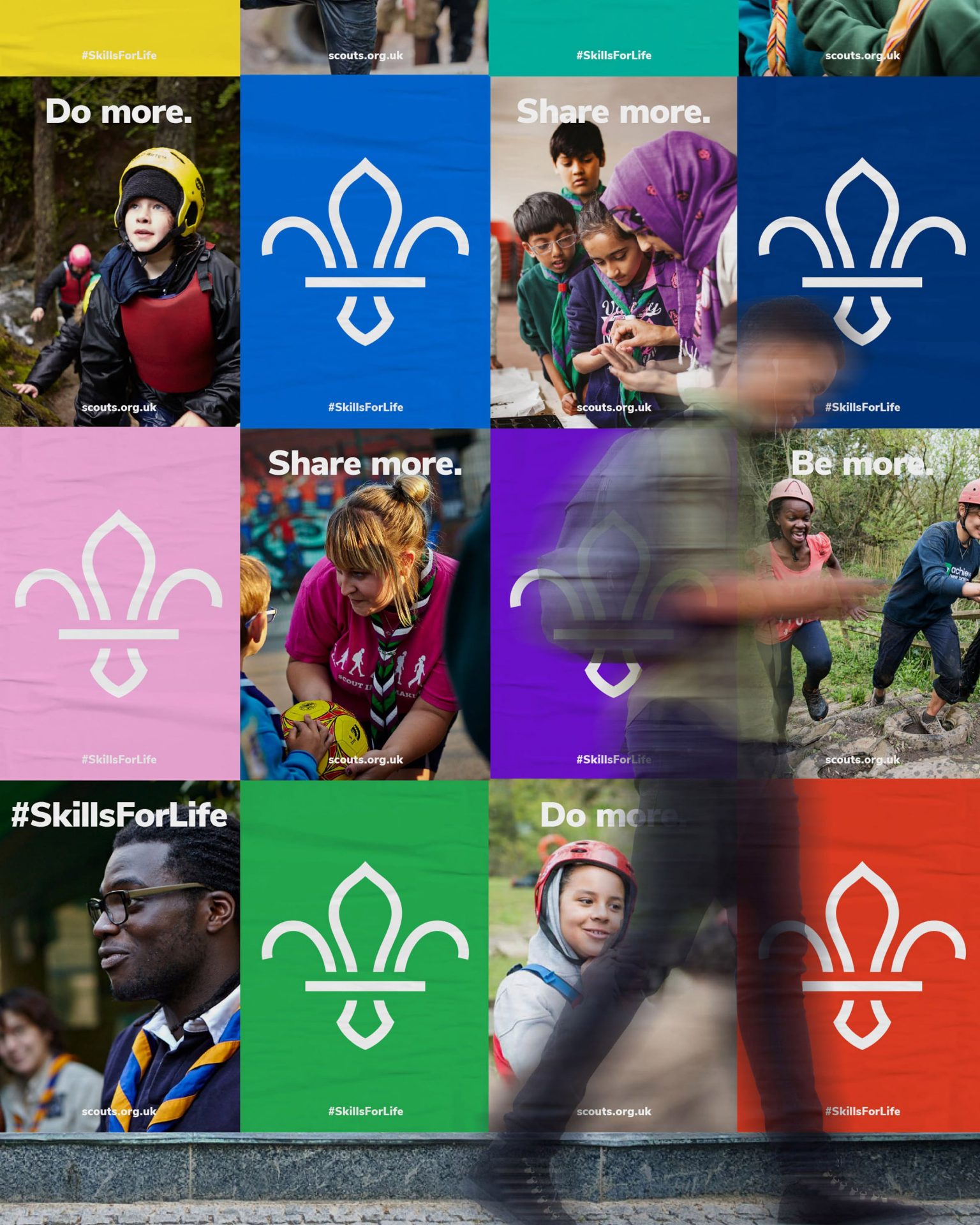
The London based design agency NotOnSunday has created a new elevated identity for the UK Scout Association. This project is part of a five year plan that the UK Scout Association created. The project was intended to shake off the old fashioned image and bring clarity and focus to the organisation. However, the strong links to its heritage were retained and the core message was not lost. Additionally the tone of voice, fonts and colours appeared more contemporary and made for digital use. The people involved always kept in mind that the look has to feel very friendly and approachable, because the UK Scout Association is such a big organisation and a lot of different people are involved.

This scouts association is the biggest in Europe and it apparently has enough resources to hire a design agency to work for a project. But this example is not relevant because of the outsourcing of the design, but the big change that the organisation was willing to make. Especially a very heritage based organisation, which was founded in 1907. This example should clarify that there is a possibility for change in a local organisation and that it can lead to an improved brand identity.


Conclusion

By analysing the current situation and having the motivation to change something in your organisation you already took the first step. But remember to always include other members of the organisation to maintain good communication and ensure that nobody feels excluded. Furthermore, check that every member of the organisation is in favour of a change, otherwise you will struggle to push your ideas and obstacles will occur. If your organisation is planning a big event do not hesitate to use project management tools in order for the event to run smoothly and use a marketing plan in case you want the event to be promoted. Additionally, try to treat your organisation as a brand, that way a lot of opportunities could come your way.

Whether you are a member of a sports club, scout association or a comic book club you will most certainly find a way to implement design management in your organisation.


Sources

Armin, 16 May 2018, New Logo and Identity for the Scouts Association by NotOnSunday

https://www.underconsideration.com/brandnew/archives/new_logo_and_identity_for_the_scouts_association_by_notonsunday.php


Entrepreneur Staff, 2020, Use these 5 steps to create a marketing plan.

https://www.entrepreneur.com/slideshow/299487


Morris Ali, 24 May 2018, Scouts’ new visual identity designed to diversify membership

https://www.dezeen.com/2018/05/24/uk-scouts-new-visual-identity-notonsunday-design/


Rampton John, 26 January 2016, How to manage a project from start to finish.

https://due.com/blog/how-to-manage-a-project-from-start-to-finish/


Williams John, 2020, The basics of branding 

https://www.entrepreneur.com/article/77408


Tackle Wicked Problems – Redesign Your Thinking

Have you ever been in an argument without the slightest hope of finding common ground? Where both parties involved felt like they were hitting a wall? Entangled in a net of allegations? Have you ever found yourself ponder problems like the Social Development Goals (SDGs)? Wicked problems so complex, finding solutions seems futile. Just thinking about solving them can be taxing.
During an argument, letting go of your initial thoughts and consider the view of the other is difficult, to say the least. We’ve all been there, we’ve all failed numerous times. How then, might we change our perspective to a whole group of “others”. Consider other people directly affected by the triggers of the SDGs. People experiencing injustices and lack?
Even though the comparison of a mundane argument and the SDGs is unbalanced, I propose, they share an attempt at a solution. What if all you would have to do in an argument, is a shift of perspective, a change of mind? What if altering your thoughts not only benefit you during an argument but also lead the way to solve bigger problems, even wicked Problems? Albert Einstein supposedly said:

“We can’t solve problems by using the same kind of thinking we used when we created them.” -A. Einstein, 1946

Thus, if redesigning our thinking will lead to new solutions, I suggest we set forth to do it right now.

A quick explanation about thinking

First of all, it is important to know how our thinking is formed and what influences it. Our thoughts evolve from our theoretical framework. Our theoretical framework is a combination of our worldview and our value system out of which we take the information for our practice (Wahl, 2012). It is the way we think about and interpret information. This framework has been establishing itself since our earliest childhood, it puts itself together out of our expectations, teachings, experiences and our family and communities (Willard, 2002).

Reframing our theoretical framework

Our theoretical framework has formed itself without us being conscious of it. Hence, with us paying attention, reframing it is possible. If we permit new pieces of information to enter our theoretical framework, we enable them to challenge- and expand it. We do this by letting go of existing prejudices and taking the time to listen, explore, ask and look. Every one of us is responsible for the way we take in information. It is a choice, whether we contemplate pieces of information that grow outside of our comfort zone or not. Furthermore, we need to make sure that we look for true information, since, it will be the foundation we work on. We should make an effort to look for reliable sources, take in and ponder fresh information, let our mind transform this information into novel ideas and actions. This will break through barriers of what we can, want, choose and therefore create.
A daring act, considering how cumbersome it can be, to change only a fragment about ourselves. Even more so, if we want to change patterns that coined our mind. Redesigning our thinking requires us to question our values and assumptions. This act may feel like an earthquake that shakes our deepest beliefs. Much like when you are in an argument and suddenly realize that you are wrong and the other is right. Or when you look at the SDGs and think “how did we ever let it come this far?”

Why bother?

Alongside the discomfort a redesign or your theoretical framework might release, there are other repercussions. Yes, it will change the way we think. However, its effects go far beyond the metaphysical. Our thoughts influence our actions. As Maturana and Varela put it:

“Every act of knowing brings forth a world. All doing is knowing, and all knowing is doing.” -Maturana&Varela, 1987

The way we act depends on what we know and how we think about this knowledge. This implicates that every practical act depends on our theoretical frameworks. If you consider the number of unresolved conflicts in your life, not even to mention the vehemence of the SDGs, it is evident that the theoretical framework of most human beings is not a union of empathy, equality and humbleness. The human condition has brought on a lot of trouble. But take heart. If our theoretical framework has been formed without our awareness, we can intentionally change it. We can ameliorate our ability to seek and digest virtuous information. Good and noble deeds will naturally follow.

Design helps!

We have established that our thoughts emerge from a place within us. A place we can mould. This process will most likely start tearing down thought patterns and convictions we have been forming since early childhood. The process will be difficult to cope with, thus, we need all the help we can get. One source of help is design.
Before you stop reading because you are tired of hearing: “The answer to a problem is design,” let me elaborate in more detail.
During their collaboration with the renowned architect Frank O. Gehry, Richard J. Boland Jr. and Fred Collopy noticed the difference between Gehry’s design attitude and their decision attitude. According to them, a decision attitude is approaching a problem with the mindset that the solution is it is choosing one of several, pre-existing options. The design attitude, on the other hand, goes beyond standard choices and creates new possibilities for the future:

“The design attitude appreciates that the cost of not conceiving of a better course of action than those that are already being considered is often much higher than making the “wrong” choice among them.” -Boland & Collopy, 2004

Design allows us to leave possibilities open. In doing so we can cope with uncertainty better and explore opportunities which might lead to unforeseen insights and solutions.

The effect of design on thought

To reform our thinking for the better, we need fresh and versatile information. So what would be a wise way to go about getting this information? You guessed it, a design attitude. Especially when we want to tackle highly complex, interconnected problems like the SDGs, shared by a multitude of stakeholders, we need an attitude that looks beyond what is already there and seeks new possibilities. An attitude allowing us to start a process, an approach or a lofty project, without knowing where it leads to and if it will work out. Only then can we lose the fear of being wrong and break through the walls our current theoretical framework has built around us.

So what now?

To reform our theoretical framework we can apply a set of practices Dave Gray, the author of “Liminal Thinking”, suggests. These practices align with the design attitude. They are open-ended, retaining from nudging you in a certain direction. Gray suggests getting in touch with your ignorance, seeking understanding and doing something differently (Gray, 2016).
Based on his suggestions I propose that each one of us starts by taking small steps in these three areas:

  • Get in touch with our ignorance: Explore your history. Ask yourself, which values you hold high, consider your past and watch out for moments in which those values were formed. Ask yourself, what the most important lessons you learnt during your childhood are. Maybe it is time to question if these values and lessons are still relevant. Most likely you will discover some blind spots you need to shine light upon.
  • For practising seeking understanding: Look for people who ask the same questions as you, even though you might know beforehand that you will not share the same answer. Be patient with them as well as with yourself.
  • Lastly, doing something different: Challenge yourself to seek new sources of information. Consider sources that are in contrast to what you’re scrolling through usually.

Let’s start reframing

Whether we want to have more fruitful arguments or confront wicked problems like the SDGs: we need to challenge our jammed thinking if we want fresh solutions. A conscious redesign of our thoughts can help. Provided that our approach is open-ended, allows for uncertainty, ambiguity and does not sift out every piece of information that challenges our existing theoretical framework. A design attitude supports this way of thinking since it gives us the option to leave possible outcomes open, without being overwhelmed by seemingly unsolvable problems. The steps each one of us can take to start with the redesign do not have to be intricate. Start small, but start somewhere. Become aware of your theoretical framework. Start venturing into the vagueness that questioning and reforming will bring. Only then, can we address wicked problems with a fearless mind, refusing to get downhearted by the uncertain outcomes of our endeavours.


References and Sources


  • Featured Image: Banksy, Love is in the Bin, 2018, Private Collection, Photo: Sotheby’s © Banksy
  • Boland jr. R.J., Collopy F. (2004). Managing as Designing. Stanford Business Books
  • Gray, D. (2016). Liminal thinking: create the change you want by changing the way you think. Brooklyn, NY: Two waves books.
  • Maturana, H. R., & Varela, F. J. (1987). The tree of knowledge. Boulder, Colorado: Shambhala.
  • Willard, D. (2002). Renovation of the heart: putting on the character of Christ. NavPress.
  • Wahl, D. (2016). Designing Regenerative Culture. Triarchy Press.


How to raise debt-free kids in a world where money isn`t real

38% of the people between ages 18- and 24 years in Switzerland are indebted. Why is that?  – Because money has become something intangible and unreal in the world of today`s youth. 

Research clearly shows the increasing numbers. More young people are indebted than ever before. Every tenth person in Switzerland between the age of 18 and 24 years old has more than 2000 Swiss francs debt (Handelszeitung, 2015). The internet generation is the demography with the highest risk of falling in debt since youngsters have only little or no control over cash money. (A. Carroll, 2015) Reasons for this are the various payment methods that one has nowadays. Today`s youth grew up with PayPal, Apple pay, credit cards, debit cards. Since many of these payment systems are deducted up to a month later from one’s bank account, the likelihood of losing track is enormous. Furthermore, having everything available at any time doesn’t make things easier. How often does it happen to you; you`re at home chilling and browsing through online shops, not thinking of anything bad and swoosh, you checked out via credit card and bought a chart full of goods? Then, at the end of the next month, you are shocked by how high your credit card bill is, right?

According to Adam Carroll, a speaker, author and financial consultant at Renzo Experience, this is a social problem that already starts at a very young age of today`s children. Kids do not recognize that all those payment systems actually need cash money to be covered. Only a couple of months ago I paid my groceries at the cashier via Twint. Behind me was a mother with her seven-year-old kid. When the little boy saw me paying with my phone, he said to his mom that he wished he had a phone as well, so he could buy himself toys with the device. This was shocking! It made me realize that especially young children, who grow up with all those alternative payment systems instead of hard cash do not know what money is, where it comes from and therefore will lose control by the time they can access and use those systems. For them, money isn’t real! How should they know better? Or how can we raise kids who know the concept and value of money? Money to young children is somehow abstract and when we as adults further the abstraction even more by waving a credit or debit card over a sensor. “This is actually the recipe for a financial disaster for them later in life. They see money as limitless because they have no concept of the back end until it comes around and bites them – in the back end.” (Carroll, 2015)


So, how can I prevent my children from falling into debt?

The most simple answer to the questions above is that we need to explain and show them how money works. This means that whenever we buy something in their presence, we must explain to them how and with what we can buy goods – money! Of importance is also that kids get confronted with hard money from a very young age. The easiest way to do so is by giving them regular pocket money as soon as they go to school. According to Luzernerzeitung, children should get the same amount of money as in which school year they are. This means during the first grade one franc per week, in the second grade two francs per week and so on. By the age of twelve, when kids start going to secondary school, it is recommended to give them rather a “youth salary” than pocket money. What the difference is? Pocket money is meant to be cash for which kids can buy things they don’t really need like sweets, small toys or public transportation tickets for their first excursions to a village or city nearby together with their friends. With a method like this, they realize that almost nothing is for free and that they must save money if they want to buy themselves something bigger and more expensive. The so-called youth salary is meant to be the first regular income with which teenagers can pay their first bills such as for their mobile phone contract and clothes which they maybe not necessarily want or need. It is also meant to be used for cinema visits and, for instance, have lunch with their fellows (Osman, 2018).  The “salary” should be between 100 to 300 francs. Dealing with a fixed amount of money will teach them that an, at the beginning a seemingly large amount of money is not that big anymore after covering all their fixed costs. Thereby, the young have  possibility to learn about money and appreciate the value it has. If children are not raised with the task of having control over their expenditures in form of hard cash from a young age on, it is very likely that they also won`t have control over their money when they`re grown up.

Statistics already show that people spend on average 12-18% more when they pay by credit cards or similar systems than if they would when using hard cash. One can only imagine how this number will increase if today’s teenagers were never thought of what hard money nor what the value of money is since it can be spent with intangible methods. Or when looking at it from the opposite, when paying with cash, people spend on average 12-18% less (Dun & Bradstreet, n.d.). Why is that? According to Frankfurter Allgemeine, it is because humans don’t feel personally connected when paying by cards or apps (Klemm, 2017). Taking money out of your own wallet and handing it to a cashier hurts. And this is exactly what makes hard money buyers more conscious about their expenses.


I have no kids yet but am still struggling with having control over my financial conditions

Now for all those who have no children yet but are already grown up and have maybe also struggles with having control over their expenditures as I had when I was younger, here is a simple trick for you. Have you ever heard of the 50/30/20 rule? No – well then, I`m going to explain to you how it works.

Half of your monthly salary should be planned to be spent on fix costs, such as rent, phone contract, insurances, food, car expenses, etc. Here it might help to write down all the monthly fix costs and sum them up to see how big the amount in total is. If it is higher than 50%, you might want to consider making some changes because, in the long-run, high fix costs will cost your neck.

Another 30% of your net salary should be planned, to be spent on pleasurable things, such as going out, traveling, shopping and so on. With that 30 %, you can do whatever you want.

The last 20% and this is very important, must be fixed to be transferred to a personal savings account, no matter what. Imagine putting 20% of your salary aside for five years. Assuming you have a net-salary of 5.5k a month saving 20% for a five years period, you end up with more than 70k on your savings account. What`s really important, is that you put these 20% away as soon as you get the paycheck. Back in the days, I always went to the bank on the day my salary was paid and transferred roughly 20% of the money to another account so I couldn`t spend it anymore.

Of course, there are lots of other methods about how to manage money but in the end, the only thing that counts is that you can live a happy life without money troubles. Therefore, I recommend to not close your eyes from reality when it comes to financial coordination in life! Only buy stuff when you can afford it and avoid payments by installments. It can end up like a rat`s tail and put you into financial ruin as soon as you lose control over it. There will be times where you have “too much” money because you didn`t go out or simply didn`t spend everything, but remember, in these months you can prepare yourself for times you might won`t have enough.


Bibliography

Graetzer, M. 2013. “Generation Minus” Jugendliche in der Schuldenfalle https://www.srf.ch/news/schweiz/generation-minus-jugendliche-in-der-schuldenfalle

Osman, I. 2018 in an article of Luzernerzeitung. Schulden wurzeln oft schon in der Kindheit https://www.luzernerzeitung.ch/zentralschweiz/luzern/finanzen-schulden-wurzeln-oft-schon-in-der-jugend-ld.129321

Carroll, A. 2015. When money isn`t real:                                         https://www.listenmoneymatters.com/adam-carroll-teaching-kids-about-money/ https://www.youtube.com/watch?v=_VB39Jo8mAQ

Handelszeitung, 2015. 38% der jungen Schweizer sind verschuldet https://www.handelszeitung.ch/konjunktur/38-prozent-der-jungen-schweizer-sind-verschuldet-777650

Klemm, T. 2017 in an article of Frankfurter Allgemeine. Wer mit Karte zahlt, kauft mehr https://www.faz.net/aktuell/finanzen/meine-finanzen/wer-mit-kreditkarte-zahlt-verliert-schnell-den-ueberblick-15046259.html

Finanzcheck, n.d. Die 50-30-20 Regel                                                           https://www.finanzcheck.de/kredit/50-30-20/

Dun & Bradstreet, n.d. Credit cards vs. cash                                                      https://www.dnb.com/business-directory/company-search.html?term=credit%20cards&page=1