What regular home office workers don’t tell you

What regular home office workers don’t tell you.

Regardless if you are used to working from home regularly or every now and then, due to the current COVID-19 situation, many of us had to quickly switch in desks for the dining table and a swirl chair for the sofa. For some it has been easy to set up a home office in a free room, but some are still struggling to find out how their laptop cable can reach the plug without rearranging the whole bedroom. Based on regular home office workers, I have collected together the most valuable tips on what is most important when designing your home office, regardless of your situation. Moreover, you will learn how to manage yourself in this new working environment, to be motivated and to work productively.

It’s all about the set up

This depends entirely on your personality and what space you have available. Most important is to have a space in which you can set up a desk and chair, where you can install your laptop and equipment without having to put it away every couple of hours. Basically, you should create a clear demarcation between your study/work area and the family’s living space. Ideally, you should have your own study, which you can lock up if necessary. This way you prevent your children or other people from entering the room and possibly disorganising and at the same time, allows you to work undisturbed. Nevertheless, it is most important that your space should really have an office character. It should be a place where you can focus on your work and implement projects. And even if it is just a large desk in the living room – an area where you can store all your important utensils and have them at hand immediately. Having your own office or a well thought-out work corner really makes a great difference and is the first step towards more productivity and organisation.

Wire management goes a long way

Tumbling and frustrating over tangled cables and wires happens quickly, but can be prevented easily.  Basic cable management can make a significant contribution to improving your office aesthetics and is quite cost effective as well – you only need to manage a few brackets and cable ties to tangle up any annoying cable clutter. Ideally, arrange yourself with your company about which equipment you must pay for and which they provide. This often are technical equipment such as laptop, printer, external hard drive, various software products, shredders, etc.

Let there be light

The lighting conditions in the office also play an important role. The right lightning provides perfect illumination of the workplace. Make sure that the artificial light on the screen does not dazzle. If this is the case, you either have to move the lamp or rearrange your desk slightly. Pendant lamps are highly recommended, which illuminate the entire room. If possible, you should make use of daylight. At best, place your desk at a 90-degree angle to the window, so that the light comes in from the right or left. Under no circumstances should you place your desk with your back to the window, as the light on causes display reflection, unless you want to leave the blinds on all day, which probably won’t be the case. It is also possible to set up the desk so that you can look outside while you work. Since the desk is probably much lower than the window, you can look outside from time to time, which also relaxes the eyes.

Eat your greens? See them!

Make your office space come alive by adding some greens next to your desk.  Plants will not only add a touch of color to your office space, but will also increase happiness and relieve stress. In fact, it might also remind you to water them every once in a while and that maybe you too, must refill your glass of water every now and then again to stay hydrated and concentrated. Furthermore, even a few plants can increase productivity. Instead of just picking all green plants, chose a plant which is easy to maintain and helps to improve the air quality. The spider plant, dracaena, ficus are beautiful and particularly well known for their air filtering qualities. To find out more, read my latest blog post on plants that are foolproof and have amazing benefits for your well-being.


Fix the attitude

As previously mentioned, the brain tends to allocate rooms with specific tasks. The same way your brain tends to differ its mood depending on your presentation. The idea of working in your PJs sounds great on paper. In reality, this will negatively affect productivity. Think about how you automatically feel like working out when you are in your gym gear, or how you feel tired when you take off your make-up after a long day. Make the effort to brush your hair and teeth, get out of your PJs and wash your face. These are the small routines and habits that make a huge different with your attitude towards your productivity and motivation to working from home.

Manage time before it manages you

As different as we humans are, as different is our way of working. One gets up early in the morning and ploughs through until the afternoon. The other starts his working day around noon and stays in the office until 9 pm. To be able to work productively, you should plan your working hours accordingly.
Despite irregular working hours, make sure to have a certain routine. Plan during which times you have calls and deadlines and then build the rest of the working hours based on when you are most productive and have no other chores. If you first have to discover the perfect time management for yourself, I recommend you to set and try out different schedules. Are you late risers and only get really productive in the afternoon? Then there is nothing to be said against starting your working day at noon. It’s better that way than getting out of bed early in the morning and not getting anything done. You can also set fixed schedules for various tasks. For example, two hours per day for editing e-mails, five hours for blog posts, one hour for taking pictures – depending on what’s on the agenda! It is most important that you are available for your co-workers, boss and customers. Be sure to define fixed working hours. Make sure that within those time you are not getting disturbed. Let friends and family leave a message on the answering machine and call back later. It makes sense to make an appointment with them in advance so that you can schedule accordingly. Everything that you don’t manage to do until you are personally determined to end and the rest of the work will be done first thing the next day.

Separation preparation

Two reasons why you should buy separate computers for work and personal use: You can claim your work computer as a business expense in your taxes and you can customise the work computers and eliminate annoying applications and software. There is hard work to be done if you use the same computer tables for creating tables as you do to play video games or watch Netflix. If your company doesn’t provide you with a separate computer, be sure to a create a new log in just for work. This way you can also save all data and passwords work-related on a different user

Give yourself a break

Regular breaks are very important. Here it helps to stretch your legs a little, maybe make yourself a coffee in the kitchen or get some movement going by stepping out into the fresh air. If you live alone, make sure to use the breaks to socialise with co-workers, family or friends. If managing breaks is difficult for you, try out the Pomodoro technique, it is a time management method developed by Francesco Cirillo in the late 1980s. It helps to work break your workday into 25-minute chunks separated by five-minute breaks. These intervals are referred to as pomodoros. After four pomodoros, you take a longer break of about 15 to 20 minutes.

Organisational satisfaction
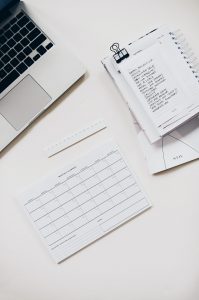
Use lists! Use them to make sure you don’t forget anything. There are many great apps which help to plan and structure your chores and working goals. You should have daily to-do lists but also weekly ones for the long term things. Set yourself goals and write them down. It helps to have a good overview and to be able to see at a glance what’s next. On the other hand, there is nothing like having a good old note block on which the daily business is written. Besides, it’s just a good feeling to be able to “cross out” work that has been done.
If setting goals make it seem hard to reach, try to set several smaller goals, which also leads to a regular sense of achievement. Even a large project can be divided into small stages. This way, you develop even more motivation on the way to the big picture and can already enjoy small professional successes in between. But even here, everyone has to find the ideal way to reach a planned goal. The only important thing is that you don’t give up shortly before and prove to yourself that you can achieve something. Motivation and perseverance are two essential aspects if you want to work organised at home. Everything else comes with time and is a nice “learning by doing”.

Now you can do it too

Regardless if you always had an office room in your flat or if your laptop took over the kitchen table. No matter how long this COVID-19 crisis will go on for, you are now ready for designing and managing your home into the ideal office space. Any how, this crisis will for sure change company’s views on remote working, giving you the opportunity to further create and better your newly designed space.

Discover how you can incorporate life-centered design into your values and what this has to do with mandarins.

The human-centered design methodology encourages designers to develop an empathetic understanding of people’s needs to design relevant solutions. But what is with the needs of our planet? How can we include every organism and life in designing our world?

The range of life

Human-centered design is tackling the importance of fully engaging with the needs of people as the experiencer. However, we are currently faced with the challenge as well as the opportunity to preserve the living on this planet. This complexity needs a new approach to tackle today’s wicked problems.

The focus on one user must change. After all, the idea of a human-centered design seems egocentric and one-sided in its purpose around people. Life-centered design means contributing to all living organisms in a way that not only does no harm but actively helps to survive and thrive.

This thought is inspired by author John Thackara, according to which one does not develop for the life of an individual, but the whole life of every organism and our planet. Everything is interconnected, people are not separate from the planet we all live on, including the major climate systems. Because everything affects everything else in one way or another, which is why there needs to be a shift towards a culture where designers address people as part of the ecosystem rather than the center of everything.

The full picture in mind

Today, we live in an era in which products and systems can communicate with each other, solve problems independently and learn from collected data and its errors. Life-centered design is part of an ecosystem of things. It raises the question of how we can enable our products and services to sustain themselves and help us make better decisions.

After all, design can no longer revolve solely around the product or service to be produced. Nor can it be specifically about the user experience. Design must now evolve to include systems of scale, and we must begin to design the business models of products and services to incorporate environmental impacts and economic externalities such as ecosystem degradation.

Unfortunately, many products are made for single use only and are therefore the very opposite of life-centered design. As an example, a great fitness device that can be used for a variety of exercises could not be included in the product range of a sports shop because the equipment rarely breaks down and therefore does not need to be repaired or replaced. In this case, the retailer could sell the product only once per customer. Instead of celebrating this type of product because of its great design, which combines durability and versatility, it is rejected for reasons of profitability.

This shows that our current economic model is designed for consumption. Companies are encouraged to produce as many versions of a product as cheaply and as often as possible. It requires a change in thinking and the intention to design something that gets by with as little waste and disorder as possible.

“If only nature would find a way to cover these mandarins so we didn’t need to waste so much plastic on them.”
– Tweet by Nathalie Gordon 

In grocery stores we find a similar phenomenon. Just recently a Twitter-Post went viral because a customer uploaded a picture from a famous food-supplier, showing a pre-peeled mandarin in a plastic packaging. An alarming indicator that our society has become too convenient as mandarins are already in the packaging, namely the most perfect packaging in the world – their skin.

Instead of an additive approach, life-centered design explores how it can design as good as nature to create products and services that complement the ecosystem in which we live, rather than harming the environment.

We as consumers should rethink what we buy and consume, but a large part of it is also on the shoulders of organizations. However, the will to change for the better must be there and organizations must recognize the opportunities for a business that works with the environment in mind.

On the example of LOOP™

Nine brands of the consumer goods company Unilever have introduced reusable packaging solutions. They are being tested on LOOP™, a global waste-free purchasing system launched a year ago. The system unites major brands and retailers with the idea of moving from a disposable model, where packaging is thrown away or recycled after use, to a circular model, where packaging is reused, and all product waste is either recycled or used in a new product cycle.

Tackling the sweet spot

If you are now wondering where to start developing life-centered goods, familiarize yourself with the innovation triangle, which can be ideally integrated into your strategy.

Similar to human-centered design, the innovation triangle can also be applied to life-centered design. In this context, we simply need to redefine what we mean by this. It is about how the ideal intersection of desirability, feasibility and viability changes and how organizations respond to it. Design must be extremely sensitive to trends in ecosystems and how they affect the triangle. This in mind, the following features are essential.

Desirability

Desirability tests whether your innovation addresses the right customer problem and accurately represents what the customer needs.

Feasibility

The second part of the triangle, feasibility, assesses whether your innovation will enhance your business and build on the strengths of your current operational capabilities.

To return to the example above, Unilever is addressing the issue of feasibility with its system LOOP™ by introducing reusable, refillable packaging to help reduce waste.

Viability

Viability tests your value chain for a long-term sustainable business model. Viable means that everything is highly desirable and feasible, but also whether you can actually make money from it.

Unilever is investing in new business models around refillable products and services that are economically viable. According to their research, they have found out that 30% of consumers buy brands because of their social and environmental impact and more than 50% are more likely to buy products that are produced sustainably.

Checklist: 6 points to consider

Take note of the following points to integrate a life-centered design approach in your organization.

1. Redefinition

Redefine the desirability, feasibility and viability of your work and consider how your offer can be made regenerative through design. Use design as a central tool to focus on transformation and the purpose of innovation.

2. Circulation

Explore new ways to create sustainable, resilient and long-lasting values. The processes of creation and disassembly of your product’s next life affects the environment and must be considered as part of the design.

3. Simplicity

The key is often simplicity. By making things durable, by keeping it minimal and without clutter, unobtrusive and pure in its intention, design can act intelligently within an existing ecosystem. Consumers should be able to use a simple return service to put as many used products as possible back into circulation. After all, if this is simple, consumer behavior can be changed permanently.

4. Collaboration

New business models must be designed to achieve the necessary changes on a large scale. Collaborate with partners to gain new insights into product development and the use and disposal of packaging.

5. Transparency

Offer customers insights and incentives about your products. Make clear that you consider natural, political and social ecosystems as equal. Show that life-centered design is your new standard, not just a project.

6. Improvement

Iteration is your friend when you integrate the innovation triangle into your process. Due to a constant gain in knowledge, many needs and expectations only become apparent in the course of development, whereby the product life cycle needs to be constantly optimized.

The foundation of a lived culture 

Although life-centered design is seen as another trend of today, it is in fact a solution for current needs. Compared to the human-centered design approach, which has been a mantra for the entire industry, life-centered design represents a significant development.

Life-centered design helps to promote a way of thinking that considers not only the end user, but all users and parties involved in production, use and disposal. To incorporate life-centered design into your values, your organization needs to look beyond the direct or indirect effects of their design activities on us humans and work out solutions with the ulterior motive on the overall system to which we humans belong.

Through continuous improvement, by responsibly shaping not only the life of a product, but also its reorientation or disposal, we come closer to designing solutions that truly work for life and not ultimately against life. Solutions that are invaluable to people, that give businesses a competitive edge and are renewable for our world.

For this reason, update your design skills with system thinking. Collaborate with others and actively design in systems that encourage people to reduce their resource consumption. We all know the expression “less is more”, but we genuinely need less things for the sake of things and more things that benefit everyone.


Sources

Cassie Robinson. (2018). Beyond human-centred design, to?
Retrieved from: https://medium.com/@cassierobinson/beyond-human-centred-design-to-501a994f3123

Fjord. Life-centered design.
Retrieved from: https://trends.fjordnet.com/trends/life-centered-design

Johnathyn Owens. (2019). 10 Principles of Life Centered Design.
Retrieved from: https://medium.com/the-sentient-files/10-principles-of-life-centered-design-3c5f543414f3

Kristan Orton. (2017). Desirability, Feasibility, Viability: The Sweet Spot for Innovation. Retrieved from: https://medium.com/innovation-sweet-spot/desirability-feasibility-viability-the-sweet-spot-for-innovation-d7946de2183c

Unilever. (2019). We’re introducing reusable, refillable packaging to help cut waste.
Retrieved from: https://www.unilever.com/news/news-and-features/Feature-article/2019/we-are-introducing-reusable-refillable-packaging-to-help-cut-waste.html

Frank Van De Ven. (Image). (2018). The three-way design thinking model.
Retrieved from: https://uxdesign.cc/the-brand-the-forgotten-child-in-design-thinking-74bc54ee4abe

Featured Image: Andrea Rico. Retrieved from: https://unsplash.com/photos/n-bUCycGItg


The thinking that will get you the design job you wanted 


Everyone knows it and everyone hates it. The process of applying for a design job. But why so? Probably because everything counts. Because every little detail on how the application is put together is perceived and valued. How it is structured, which font is used, and so on; it is the whole package that indicates your value in the market. While a finance-guy could simply use a template on Word, you would dig your own grave with that in the design realm. Applying into a design agency is a science for itself. 

The world-wide-web nicely caters hundreds of checklists, how-to guides, and videos on that topic, but as it seems like, it is still not done properly. What already sounds frustrating in the introduction and seems like a hopeless task, is actually a good thing, my friends! With a little bit of focus, this means there is space for us to excel in our application. What that differentiating focus could be and mean, you will find here. Step by step. 

The observations I made with these endeavors so far are that I often got lost early on, started wrongly altogether or straightly dove into a strict portfolio-mindset, all of which resulting in an unfinished and non-satisfying outcome. That’s why I decided to get to the bottom of that seemingly hateful process and find out what thinking could guide us in this self-portraying project.


1.  Do some soul searching 

First and foremost, ask yourself what you want to do and where your passion lies. There is plenty of other fish in the sea, but no one is just like you. So this initial question is fundamental. Not only for your professional career but more in a general context. We all know the classic: “Where do you see yourself in 5 years?”-question. This one will follow sooner or later and we should all be able to truthfully answer it to ourselves. Be sure to know what you want to do in your life and on what to focus, it will make planning your future much easier. Ask yourself questions like “what did I enjoy the most in my studies?”, “what was I specifically good at?” or “what made me smile or feel like opening a bottle of champagne?”.  

If this is not enough and you’re still unsure, the next step can be to find someone who is already working in an agency or corporation and talking to the people from this profession. This can give you guidance and vision about the direction you could go. Also, it will get you some understanding and sense of reality and could set straight false assumptions or underline correct ideas of yours about the job itself.

This is a very important point. How can you show yourself in the best light if you don’t even know where it is yourself?

2.  Tell your story well

As soon as you know your strengths, your style, and your preferences, it is time to show them well. As a designer, you know that I’m talking about the portfolio, this is where you can give a good account of yourself. The general idea of a portfolio has shifted a lot in recent years, it nowadays is more about telling a story and presenting yourself as a human being, instead of a worker and performer only. People hiring for design roles are keen to see your versatility, want to feel that you can display a set of soft skills and that you can work in a team. So, when you think of the portfolio, you should think about the document that contains more than just your work. A proper representation of yourself, your experience and your personality.

In what form you wish to set up your portfolio is all up to you and your own judgment. Keeping in mind that we live in the age of digitalization, which not only means you should be able to set up and build your online presence, but also take into account that the potential employers can much easier access your data. It definitely does not shed a bad light if you can show your affinity of using modern ways of communication and maybe even your ability to learn new things. On that note, there are quite a few simple-to-use online services that can help you build your portfolio as a non-professional (Squarespace, Wix, Readymag, to name a few). Be aware though, the professionals easily notice the difference between templates that have been altered or not, so this is a great opportunity to bring in your own style and show that effort has been put into it. This will make your online presence authentic and, again, shows your creativity. 

The portfolio is the first impression your desired company will have from you, so here are some tips to consider when introducing your projects: 


  • What was your role?
  • Was it a group project or individual work?
  • What was the background of the project? 
  • What were the goals of the project? 
  • Who were the users you design for? 
  • What problem needed to be solved? 
  • How were you planning to solve those problems on that matter?


As designers, we know that it is not only about making things beautiful but much more about using the right processes and storytelling to create great solutions, tailored to the end-user. So this is where you can proudly document how you work, what methods you are familiar with and how you apply them to reach that final result. Short and punchy background information of your skill-set completes it nicely. 

3.  Research like a real designer 

A job application in design always means entering into a collaborative environment, where you will work with other professionals. So when it comes to looking for a job opening or a company that would fit your dreams, which I would personally suggest going for in the first place, it is crucial to make sure to build your career in a corporate setting where you can thrive in. In the end, people who you surround yourself with will be the ones that really affect your further career. So how would you know beforehand, if it would be the right place for you to work? Through extensive research.

Think about it that way: Who is out there, moving into a direction which you would want to be part of? What do these companies have to offer to you? What do they do well, and what not that much? What are the corporate guidelines and how do they portray themselves and their co-workers? Design agencies mostly take good care of their online presence and you will surely be able to detect some characteristics of their internal culture. Look out for the design language they use and see if it seems familiar to you. Overall, actions mostly speak louder than words, so go and explore their latest projects or upcoming events. You might even want to consider going to public events of theirs to network and talk to the people directly.

Get to know a company in-depth before you decide to apply for it, this will not only save you a lot of time in the whole process but also broaden your horizon on the market situation and what is happening in the field. The insights gained in the detailed analysis hopefully ignite your motivation and provide reasons for why they are the perfect fit for you and why you are theirs!

4.  Cover letter as your entry ticket 

After you sparked their interest in the portfolio they will turn to your cover letter. This is your personal voice, speaking to the company. It could be your entry ticket to the table, so don’t waste this opportunity to show that you went the extra mile in this application process. After you’ve done all the research, you will be able to not only present yourself in a professional, promising and surprising way, but it will also allow you to show them how well you know them already and what your contribution to their operations could be. Tell them, where you imagine yourself within their organization, how you would embrace their values and where you possibly even see potential opportunity areas for the future of their company – positively and enthusiastically. 

For the heads of design, the application stands and falls with the cover letter, which could be the deciding factor over an interview invitation. This is where your designers’ mind comes into place, how far can you switch perspectives and put yourself in the position of the other, in this case, the company’s allocated person reading your application?


The bottom line 

What it all comes down to is:

1. Do your homework, not only on the company but also on yourself.

2. Know what you’re talking about and don’t just tell them how great they are and how much you would want to work for them, but state what and how you could contribute to their success and what they’d gain from having you in their lines. 

3. See it as the opportunity to differentiate yourself from others.


4 Ways to improve & excel in remote teamwork as a design management student

The current crisis forces people around the world, including us students, to stay inside – still performing and producing solid work outcomes. The crisis also forces a lot of Swiss design students to participate in seemingly endless video-conferencing meetings, staring into a screen for most of the day. Studying design management myself, I am consistently solving wicked problems and designing for the future. For the most part in teams.

As part of Generation Y and Z, we are used to double-tap on pictures and comment on what we like on social media platforms. We do not struggle with using online search tools and software for the most part. We most likely deal with error messages just by closing the window and moving on with our day. Also knowing how to behave best in online meetings. Which for example means to follow the netiquette by turning off the microphone when not speaking. It all does not seem to be too big of a challenge for us students. Right?

Still, the current times ask for different, new measures. As students who normally work in creative thought and workspaces, we are challenged to find new ways to successfully communicate ideas, project updates, and design inputs online.

This blog entry is thus meant to share four helpful insights on how to improve your communication and teamwork online. It is meant to empower you to keep successfully designing for your group projects. So here we go.

Use timeboxing to improve productivity

Working remotely means less social distraction and it seems as if we have less capacity and patience for online chit-chat. Therefore we tend to jump into work right away. This can be a beneficial side effect to increase productivity in teamwork but does not mean that we can end up in long, demanding discussions. If you find your team and yourself in a discussion rut consider using the timeboxing method.

Timeboxing is a technique to fix a certain time frame for an activity in advance and set a timer for it (Orgler, 2016). Orgler explains in his blog post, that there are two different kinds of timeboxing which are called soft and hard timeboxes. For the soft one, you allocate a certain time slot to a specific task or discussion topic but are allowed to finish it even after times up. Whereas for the hard time box you are asked to take a break or drop your work and head to the next task on your agenda (Orgler, 2016).

It is important to visually show the time running for everyone, so go ahead, share your screen and use a web timer. Agree as a team on the length of the time box for each task. Remember to not go on for too long, as we get tired more easily working online. As a reference, working with time boxes in a workshop is often structured with 60 minutes in total. Which means 45 minutes of work for each agenda item and a 15 minutes break afterward. For university and school projects online, this might possibly too long, so make sure to adjust your schedule accordingly.

Adapt existing design thinking methods to work online

There are plenty of design thinking methods out there that help us to connect and share thoughts differently. So, if you are struggling to get creative whilst working remotely, consider picking up a method and adapting it to working online.

An example of such a method is the Liberating Structures method 1-2-4-all. This method is based on five structural elements, which are 1 minute of self-reflection and jotting down ideas, 2 minutes of sharing these thoughts with someone else, 4 minutes of sharing in teams of four and 5 minutes of sharing insights within the larger group (Liberating Structures, n.d.).

For online purposes, however, the application of this method would mean to create break-out rooms to split up. To avoid extra time and energy efforts to start separate meetings, consider taking the base idea of the method – which is to first think for yourself and then with others – and take 2-3 minutes to personally jot down ideas, thoughts, inputs on your project and then take up to 10 minutes to share in your team. Just make sure to turn off your camera and mute your microphone for your self-reflection time.

Find helpful tools to creatively collaborate

Productivity is just one side of the coin but what about creativity?

To do structured tasks online collaboration does not seem to be that big of an adjustment. But when it comes to sharing ideas that go beyond verbal, structured communication, we can feel the restrictions of not having face-to-face interactions.

Knowing a handful of online tools to choose from therefore comes in handy. Tools such as Figma, Sketch or Miro enable designers to collaborate in real-time on the same overview (May & Cahill, 2019).

One of the best tips I ever received concerning reading books is just to stop reading it if it does not captivate me after a while. There are so many books out there so do not waste your time on one which does not read well for the time being. You can always pick it up again at a time where the content might be more appealing to you again. I found the same to be true for online work tools. Do not waste time on straining your team and yourself with working with a tool. Try it out and if it does not feel right, drop it and try out another one. Trial and error can feel exhausting at times but your team will come out stronger and smarter, after finding new ways of working together.

If you and your team find it to be hard to pick up a new tool within a short period, maybe there are already known tools such as Keynote which can help you simplify your life? And do not underestimate the power of a shortly sketched visual on a piece of paper held into your camera to communicate what you want to explain to your team members. Keep the ideas coming.

Foster changing your team culture and work environment

It is not a new phenomenon for communication to be key in a group. It is also no secret that our ability to communicate influences the effectiveness of our teamwork.

But while doing all the work talk we lack social connection when working remotely. In a digital, remote workplace where boundaries often get blurred, the importance of strong team culture is hence not less essential. So how can we improve our team spirit while working from home?

On the one hand by intentionally taking time to catch up and small-talk as a team, even when restricted to toast on each other online. This can be simply done by just checking in 5 minutes before the official meeting starts or at the end of a meeting. You can also be bold and ask others to chat outside of working hours because you might just be too tired to talk right before or after a team meeting.

If you are feeling your teamwork is unsatisfying or simply want to upgrade your team culture there is the opportunity to do an online reflection via an online whiteboard tool called Mural.co. Reflect on what has enabled effective remote work and what has hindered effectiveness in your teamwork and follow the four easy steps explained here (Toolbox Hyperisland, n.d.).

Besides personal connection, we also lack movement when working remotely. Studies show that walking helps us to diverge our thinking (Richdale, 2020). So if all the teamwork tries to burden you and your team members just go on a walk together and ditch the video-conferencing for a no-camera-just call walk. After all, you have the freedom and flexibility to do it in current times like these. This is your opportunity to start working differently, to change settings more often than usual and to break out of your normal work and study environment. Walking gets your mind going and helps to shift your thoughts when feeling stuck.

Cease flexibility and run with it

Even when facing changes in working together, we can still manage to be successful design students by adapting to our given circumstances, working remotely from home. We are Generation Y and Z students, currently even more immersed in the digital world, but we are also after all capable to learn, apply and improve. We are equipped with the knowledge, methods, and tools we need to become ever more flexible in how and where we work. Let’s focus on the possibilities we have and the freedom we can gain from them.

For more inspiration and reminders on methods and tools to use visit designkit.org/methods or toolbox.hyperisland.com.

Sources

May, T., & Cahill, C. (2019, December 23). 52 web design tools to help you work smarter in 2020. Retrieved from https://www.creativebloq.com/features/best-web-design-tools

McCandless, K., & Lipmanowicz, H. (n.d.). Liberating Structures. Retrieved from http://www.liberatingstructures.com/1-1-2-4-all/

Methods. (n.d.). Retrieved from https://www.designkit.org/methods

Orgler, M. (2018, December 29). 7 secrets to master timeboxing. Retrieved from https://medium.com/dreimannzelt-adventures/7-secrets-to-master-timeboxing-66a744ea9175

Richdale, A., Pearce, D., Moore, A., Kosner, A. W., Richdale, A., Richdale, A., … Richdale, A. (n.d.). “Sorry, I have a walk scheduled then”. Retrieved from https://blog.dropbox.com/topics/work-culture/-sorry–i-have-a-walk-scheduled-then-

Team Remote Working Charter. (n.d.). Retrieved from https://toolbox.hyperisland.com/team-remote-working-charter


Quarantine-Design: 10 Affordable and Easy Tips for your Wellbeing at Home during the COVID-19 Crisis

As a certified yoga teacher and passionate wellness advocate, I decided to put together 10 easy and accessible tips for quarantine-friendly living during the current COVID-19 crisis. Though these wellness tips are universally applicable, you may feel heightened sensations of anxiety, confusion or stress, experience a lack of physical movement, or you simply want to increase the feeling of wellbeing while your (not-so-voluntary) home stay. By following these 10 tips, your home will become your sanctuary during these stressful and uncertain times.

1. De-Cluttering

The probably biggest and most impactful thing you can do at home is to create a harmonious space, trying to minimize the physical clutter in your home. Countless books and blogposts have been already written on how to best approach this.

Marie Kondo, the world-famous de-cluttering author, suggests an easy-to-follow plan to achieve lasting results: Gather your belongings into categories and subcategories. In each category, pick up the object and ask yourself if it brings joy. If it does – keep it, if it doesn’t – discard it. Store the items from each category in one place.

When being forced to spend so much time at home, you want to make sure to create a space that makes you feel relaxed and at ease. By getting rid of the items you don’t really enjoy, you create more calmness, so your mind can focus on what really matters to you at the moment. Your nervous system is very likely already busy juggling so many new feelings and changes, so decreasing visual stimuli helps to promote your mental wellbeing.

2. Room Climate

You do not need to understand the principles of Feng Shui to create a positive room climate. Airing your room, apartment or house is a great way to significantly improve the room climate and increase oxygen levels, which again are important for proper brain function.

Another easy way to improve your room climate is through smells. Diffusing essential oils or using aroma sprays stimulate the smell receptors in your nose, which then send through your nervous system a message to your limbic system, the part of the brain that controls emotions. The following essential oils are great for home use:

  • Lavender: soothes stress, calming, promotes healthy sleep
  • Frankincense: immune booster, relieves stress, anxiety, depression and headaches
  • Cypress: grounding during difficult times, soothes stress and overwhelm
  • Sweet Orange: refreshing, energising, balancing
  • Bergamot: raise low spirits, soothe anxiety and worries, refreshing and uplifting

Companies, like Farfalla, offer aroma blends for different purposes, in spray form or for a diffuser. Ideally, use the aroma after airing.

Other big impacts on room climate are frequently cleaning the house, especially making sure the windows are clean and clear. Further, relaxing music can help calm down the nervous system.

3. Greens

House plants offer many benefits for the atmosphere in a room. Next to producing oxygen and lowering the amount carbon dioxide in the air, they help to keep the air humid. Especially during dry winter months, this is beneficial for skin and the respiratory system. The humidity also makes it harder for viruses to survive and transmission. The plant leaves and roots both absorb and store pollutants from the air, which makes them great air purifiers, too. Especially great common plants for this purpose are the Peace Lily (Spathiphyllum wallisii), golden photos (Epipremnum aureum) and common ivy (hedera helix).

Next to green plants, fresh flowers will have an uplifting effect. While florist’s shops are closed, most of them offer a delivery service during this time. Maybe check out your favorite flower shop’s homepage and give them a call. Not only will you improve your own mood, but also support small local businesses during these uncertain and challenging times.

4. Textiles

Your home textiles are quick to gather dust and other pollutants, so making sure they are well cleaned can improve the freshness of your home. Try to air out your blanket and pillow every morning, and shaking out your quilts, carpets and cushions weekly.

Next to keeping your home textiles fresh by airing them, make sure to wash your bedsheets weekly, if you’re not doing that already. White or natural-colour bedsheets can be lightened with a natural, oxygen-based bleaching complex and stain remover. Fresh, crispy white sheets will give you the feeling of waking up in a hotel bed every morning.

5. Home-Office

Dedicating an area in your home to set up a home-office might help you to become more productive and create some structure in your space. It is very tempting to work from your bed, but try to avoid this and honour your bed as a space for sleep and relaxation. Set up your laptop in a place where you can sit comfortably, making sure you have enough light and surface area for any other objects you may need. Set up your cables in a way that they are easily accessible and clean. Prioritise ergonomics, and make sure you have some water or tea nearby to stay hydrated. Further, get dressed like you would normally during a day at the office. Changing your clothes can help you to foster the right mindset for being productive even from home.

6. Meditation & Movement Area

If you have the space, I recommend allocating an area of your space to movement and meditation. Just like honouring your bed for sleep and relaxation, your home-office setup for productivity and work, your meditation and movement area should be calm yet gently stimulating. Maybe you have a mediation cushion, but normal cushions or a folded blanked work equally well. You can set up a little altar with candles, maybe a manual for breathing exercises, flowers or an inspiring image or moodboard. Whatever it is for you, make sure you air out the space before you start your home meditation or yoga practice. Here too, aroma sprays can help you set the mood, depending on your needs. Incense sticks are popular as well, but due to potentially hazardous side-effects on your respiratory system, I don’t recommend them.

7. Self-Care Rituals

Especially in times of worry and uncertainty, self-care rituals are important anchors for grounding you in the present moment. Taking care of yourself can look different for everyone. I recommend breathing consciously or meditation, and doing gentle yoga, dance or exercise. Moving and conscious breathing helps to release stagnant energy in your body. Self-care can also be reading a book, or consciously indulging in your favourite series or movies. Travel with your tastes and try new recipes. Do something that lifts your spirit and makes you feel good in your skin. Also, make sure to keep a healthy sleep rhythm with around seven to eight hours of sleep per night, and remember to reduce screen time several hours before going to bed, in order to not interfere with your body’s melatonin production.

8. Mental & Physical Health

As mentioned above, like self-care rituals, it is important to focus on your physical and mental health. Being home for a long time can cause feelings of anxiety and depression in many people, as routines and movement is minimized. Mentally, it is important to become aware your state of being and to breathe through it. Here, too, I highly recommend breathing exercises like Nadi Shodhana or Ujjayi breathing, as well as Yoga Nidra. All these can be looked up on Youtube or Google, there are numerous websites offering great tools and resources for your home yoga practice. Relaxation helps to boost your immune system, so eliminating stress through mindfulness practices is an accessible and free tool to promote health and resilience. To take care of your physical health, make sure to include an abundance of fresh and raw fruit and vegetables into your diet, and decrease the amount of highly processed and pre-packaged food. Whole plant foods help to minimise the stress on your body. Further, taking warm baths help to activate your immune system. You can also supplement with vitamins like D3, B12, and C, as well as minerals like Zinc. Exposing your skin to the sun for 10-15 minutes daily naturally helps to active vitamin D production in your body, as well as improve your mood. Anti-viral agents like ginger, garlic, green tea, elderberry and echinacea are great to include in your diet or as a supplement.

9. Social Contact

One important aspect to improve mental health is to stay in social contact through phone calls and video calls. Especially for those living alone, calling your friends or family is crucial for mental health to prevent feelings of loneliness or social isolation. Share your thoughts and feelings about the situation and know that you are not alone. Maybe you take a virtual coffee break with your friends or colleagues, discussing non-work-related issues. You can even organise a nap call with your friends. While real social interaction is important, try not to compensate this by spending extra hours on social media platforms like Instagram or Facebook, as they are known to promote anxiety and a sense of isolation. Consume mindfully when being online.

10. Being

Lastly, and most importantly, you don’t need to treat this time as the opportunity to get your life together, become super fit or finish every point on your to-do list. Know that your mental and physical wellbeing have highest priority now, and that you can treat this time as a period for reflection and self-care. Think kind thoughts and speak compassionately to yourself. There is nothing to achieve. Dealing with this situation is for many people already enough, especially for those already prone to anxiety or depression. It is perfectly ok to simply be, look out of the window, get bored and do nothing productive at times. Try to change your mindset from a hyper-active, over-stimulated and worried one to a grateful, loving and accepting one.

Final Thoughts

These were my 10 tips on how to design your quarantine, so it promotes your physical and mental wellbeing the best way possible. The current COVID-19 crisis requires you to put special emphasis on your personal wellbeing.

Wellness is largely a question of the mind and the conscious engagement with your physical surroundings. Close your eyes, take a deep breath, and know that you have already all that you need to be well – right now and right where you are.


Are you a diversity champion?

In our design management studies at the Lucerne University of Applied Science, we have a lot of project work in diverse teams of four to six people. Each semester, we work at least in three different teams to engage together in a creative endeavor towards a goal set by the lecturer. Sometimes we form our own teams, other times our teachers form the teams. As our studies are international and at the edge of two disciplines, design and management, we have a very diverse class. Not only is the age range around ten years, but there are also more than five countries represented and many different industry backgrounds. One could think that design management students are diversity champions and understand the benefits of diverse teams. However, looking at my experience so far and observing our class, there is still a great challenge around the topic of diversity and many people have a strong preference for whom they want to work with. It becomes especially obvious when the class gets the chance to build the teams themselves. This often results in a nervous atmosphere and frustrated people.

In this blog, I want to explore three questions: Why is it such a challenge to work in a diverse team, how can the teamwork experience be improved and what are the benefits of diversity and inclusion on creativity and innovation? By looking at these three questions, my goal is to find out how design managers can improve their experience of working in diverse teams, and how we can help to manage diversity and inclusion in companies. For the reader, it is important to know that diversity in this article describes not only differences in gender and culture but also takes into consideration the difference of career paths, industries, academic backgrounds, and age.

One of the most important challenges of working in a diverse team is leaving the comfort zone and understanding the opinion and ideas of other team members. Diverse teams have to deal with the differences of each member to understand how to reach the goal together. This often means that everyone has to leave their bubble and tap into the beliefs of others to understand their point of view. In his book Liminal Thinking (2016), Dave Gray describes this problem of our bubbles with the term of self-sealing logic. The concept of self-sealing logic depicts that people often take their assumptions as facts and build the rationale around them. People start with conclusions and only then try to create the rationale for this conclusion. One reason for this behavior is that it feels safe to stay in one’s bubble and that it takes energy to question the beliefs and assumptions one has built over the years. Consequently, it is crucial for a successful team collaboration that each team member overcomes the assumptions and beliefs in his or her bubbles as otherwise they only accept concepts that have internal coherence. Internal coherence describes the situation, when an idea fits into the current beliefs and assumptions without challenging them. When working in diverse teams, this can lead to conflict and failure. It is not an easy task, but one can start by raising the awareness around their bubble and questioning where the beliefs come from. This will result in better understanding team members and having more success in reaching a  consensus. Team members will feel more comfortable in the team and are therefore more likely to be creative.

Next to the awareness of each individual, the working environment also has a huge impact on the success of diversity in teamwork. As stated by Rocío, R., Voigt, N., Schetelig, K., Zawadzki, A., Welpe, I., & Brosi, P. (2017), five work environment factors are crucial to develop the valuable asset of diversity into its full potential. First of all, the environment must allow openness to cognitive diversity. This means that team members should feel free to speak their minds. Constructive conflicts and opposing ideas should be encouraged and supported by the company or working culture. Secondly, diversity should get support from the top management which means that it becomes a strategic priority. This could mean that the CEO endorses an inclusivity initiative or similar affirmations of the C suite. Thirdly, managers should listen to their employees and practice a participatory leadership style. It is important that not only coworking people feel understood when collaborating, but that line managers also actively listen to their subordinates and take their opinions into account. Fourth, the company should have equal employment practices. One example is that a company should avoid pay differences in salaries as this can cause conflict. Another example is the benefit of having more women in leadership positions. As mentioned by Zenger, J., & Folkman, J. (2014), women perform better overall in leadership positions than men, with the biggest differences lying in skills like taking initiative and practicing self-development. The fifth environmental factor that can help diversity to unleash its full potential is frequent personal communication. If the company or a team can facilitate informal exchange between people with different backgrounds, it can support the employees to create relationships and be inspired by colleagues. If all five of these environmental factors are well managed, the company can harvest the rewards of diversity due to these inclusion initiatives.

In our studies, it becomes clear that the environmental factors play a crucial role in the success of the team. After three semesters of studying, we learnt that at the beginning of a project, we should talk about our expectation, strengths and weakness, to build trust and create the basis for a successful collaboration. Further in the project, we start every meeting, with an informal exchange so that the team members have the chance to form relationships beyond the professional context. We call this check-in. One of the most difficult aspects of teamwork in our studies is to create an environment of constructive feedback and active participation. Team members often either strongly identify with their own concepts and become hung up on them or avoid exposing themselves and just agree to everything. Walking this thin line between participating in discussions but not identifying with one’s own ideas is challenging and should be addressed by the team. Our team working skills have evolved a lot since the beginning of the studies and each semester new insights improve our collaboration.

For design managers, it is especially interesting to better understand the correlation between creativity and diversity. The idea that diversity enhances creativity is not new. According to Viki (2016), artists like Picasso and Hemingway looked for inspiration in foreign countries. Immersing oneself in a foreign culture can strengthen the ability to produce creative results. Translated into the corporate world, this means that being exposed to multicultural experiences can enhance the idea flexibility and capacity to connect concepts. Many studies have been conducted to understand the reasons behind this and they all had the same conclusion: The ability to integrate different viewpoints and insights results in greater levels of integrative complexity, which is at the core of those eureka moments of creativity. Diverse experiences, and being able to understand underlying differences, strongly boost this ability. Design Management is about taking advantage of these benefits.

But what benefits does diversity have? According to a study by Rocío, R., Voigt, N., Schetelig, K., Zawadzki, A., Welpe, I., & Brosi, P. (2017), there is a positive correlation between diversity in management and innovation. As a result, companies with higher diversity therefore also have more successful products and can create more profit from new products and services. Especially if a company has several different product lines or operates in different industry fields, it has an increased benefit. Furthermore, a study performed by Hunt V., Yee L., Prince S. (2018) shows that there is a positive correlation between companies’ financial performance and cultural, ethnic and gender diversity, particularly in executive teams. The study analyzed more than 1000 companies in 12 countries. It showed that the companies with the most diverse executive teams were 33% more likely to perform better than their competitors. Also, companies in the top 25% for gender diversity in executive teams were 21% more likely to outperform the industry’s average EBIT margin. The reason for this improved financial performance is that these companies attract top talent, better their customer orientation and customer satisfaction as well as have a superior ability to make decisions. To sum up, both studies show that companies with more diverse teams are more successful in innovation and generally do better in their financial results.

To conclude, it is clear that diversity in teamwork is a desirable state. However, it is important to understand that each individual needs to contribute to the success of a team, as there are many challenges involved. There is a potential for conflict, which should be well managed and developed into a culture of constructive feedback where opposing ideas are encouraged. Each person needs to be aware of their own beliefs and try to understand the viewpoint of others. Design managers need to be aware that diversity needs to be managed and that the environment has a crucial impact on the collaboration of diverse teams.  The benefits that can result in successful collaboration are clear. By enhancing the ability to innovate and the creativity of teams a company can gain a competitive edge. In the end, this means that diverse companies can also generate more profits compared to uniform ones.


Bibliography:

Gray, D. (2016). Liminal thinking: create the change you want by changing the way you think. Brooklyn, NY: Two waves books.

Rocío, R., Voigt, N., Schetelig, K., Zawadzki, A., Welpe, I., & Brosi, P. (2017, April 26). The Mix That Matters: Innovation Through Diversity. Retrieved from https://www.bcg.com/publications/2017/people-organization-leadership-talent-innovation-through-diversity-mix-that-matters.aspx

Zenger, J., & Folkman, J. (2014, July 23). Are Women Better Leaders than Men? Retrieved from https://hbr.org/2012/03/a-study-in-leadership-women-do

Yee, L., Hunt, V., & Prince, S. (2018, January). Delivering through diversity. Retrieved March 14, 2020, from https://www.mckinsey.com/business-functions/organization/our-insights/delivering-through-diversity

Viki, T. (2016, December 8). Why Diverse Teams Are More Creative. Retrieved from https://www.forbes.com/sites/tendayiviki/2016/12/06/why-diverse-teams-are-more-creative/#7a7eb39a7262


How to explain design management in a job interview

Design management applies to several different fields, disciplines, and industries. The attempt to narrow it down and box it into a one-sentence-definition will lead to confusion and will not do the complex term any justice. Yet, the Design Management Institute gave it a try and defined design management as follows: “Simply put, design management is the business side of design.” (n.d.)

Well, this does not really help us making the terms more feasible and understandable, does it? The 10-words definition does not express any practical applications – design management remains hard to grasp. One common situation in which you as design management international (later referred to as DMI) students or graduates will be asked to explain design management, or rather the value of it, is during a job interview. And usually, you will be talking to HR specialists or recruiters who typically do not have any background in design. So, how can we explain design management in a job interview to such interviewers who do not have any prior knowledge? By the end of this blog article, you will know the answer.

Before sharing a collection of hands-on examples and explanations, I would like to emphasize that these recommendations are based upon my personal experience. While looking for an internship position in summer 2019 as well as 2020, I completed several assessments stages and was invited to various job interviews. This led to the realization that there are no right or wrong answers to such a question; however, effective answers highly depend on the job you are applying for. Hereinafter, I will share my personal recommendation on how to explain design management in a job interview, highlighting general benefits that are of value to any company.

Sell, don’t explain

First and foremost, be aware that you are in a job interview – in a situation where you aim to convince the person in front of you of your skills. This means, of course, you need to explain to them what design management is but more importantly, why your knowledge is of value and benefit to their organization.

This is why I recommend you to put yourself in the shoes of your (possible) future employer. What is relevant to them? What do they need? How does design management add value to them? According to this information, adjust your explanation of benefits tailored to the organization. This could be done for instance by researching about the organizational culture. Let us say at the core of the company’s values lies an innovative spirit. In that case, I would suggest finding concrete examples of why you would fit into such an organization that stands for innovation. In this example, one approach could be to mention what products or services you have innovated as part of your DMI degree – maybe during the course “innovation lab”? In any case, you should always remember that whatever you say should not just explaining how you fit into the organization but confirming the recruiter that you are the exact right fit for the job, beyond any doubt.

Describe the courses you completed

One way to make design management more tangible to someone from a different field is by concretely mentioning courses that form part of your DMI Bachelor’s degree. Again, I propose to mention the courses that are most relevant to the desired position. Let us assume you are applying for the role of a marketing intern. In that case, I would recommend stating that the undergraduate program involves courses such as marketing, communication design, trend research, user research, campaign management or project management. All of these courses are highly relevant in marketing and enhance the interpretation of what your skillset as a DMI student or graduate consists of. In that case, any person even without prior knowledge in design will gain a clear understanding of your qualifications by knowing what courses you successfully completed. This is why I propose to introduce the individual courses that are part of the DMI program during a job interview.

Emphasize your design background/experience

The DMI Bachelor’s degree program is open to students from almost any background, whether in management or design. Regardless of the individual experiences, any student will be taught a basic design understanding throughout the program. From my very own experience, I can tell how much appreciated such a design understanding is. After the first year of DMI, when I was in the position of a “creative marketing intern” at a beauty company in Singapore, my supervisor was impressed by the way I was able to collaborate with the inhouse designers as I understood their daily business. I knew how to use the Adobe programs and was able to work with the graphic designers instead of just giving them a brief to implement. Also, the way I created design briefs for marketing campaigns set me apart from other interns who came from a solely business background. Trust me, you are not even aware of how much you know about design (from a technical perspective) until you work with business graduates. Consequently, I am convinced that in any role, having a basic understanding of design is of great value to any organization – and definitely something you should mention during a job interview.

The best of both worlds

The most basic explanation of design management that you could possibly share at a job interview is describing that it is the “best of both worlds” – meaning that you were taught design skills as well as business and management skills. In other words, you know how to solve business matters in a more creative and human-centred way. I am aware that design management is a lot more than just the mixture of “design” and “management” but it might be one of the most effective means to make it feasible to people who have not been introduced to the topic before. For instance, you could explain to your interviewer that you know how to set up a financial plan for a business, and at the same time, you know how to develop the service that is part of generating the revenue of that business. For this reason, depending on your interview partner, I suggest describing the value of design management as bringing in both a design as well as a management perspective into the team, the organization or the tasks you will be faced with.

Soft skills, soft skills, soft skills!

Soft skills are people’s abilities to communicate with each other and work well together (Cambridge Dictionary, n.d.). The Forbes Magazine shared that soft skills training boosts productivity and retention 12 per cent and delivers a 250 per cent return on investment as a result. Also, Deloitte’s 2016 Global Human Capital Trends report states that executives identify these skills as crucial to fostering employee retention, improving leadership, and building a meaningful culture. Even 92 per cent of all respondents rated soft skills as an essential priority (Bruce, 2017). Long story short: companies out there know how integral soft skills are. And the DMI undergraduate program provides you with such. At the core of design management lies creativity and effective problem solving, two of the most valued soft skills. Besides, DMI students learn to work in teams and collaborate with various stakeholders – another soft skill recognised as essential. Equally important are communication skills, which are also taught along with the Bachelor’s program. And last but not least: Adaptability. Design management encourages you to be curious and to navigate confidently through uncertainty. This teaches you to adapt quickly to various scenarios. As a result, I strongly recommend explaining the value of design management in a job interview by pointing out how the program develops its students’ soft skills.

Conclusion

You as a DMI student or graduate have now read about various suggestions of how to explain design management in a job interview. I invite you to use these ideas and truly “sell” your value, tailor your answer to the organization, describe the courses of the program, emphasize your design background, outline the mixture between design and management, and highlight your soft skills such as effective problem solving or creativity. Still, I understand that regardless of your individual circumstances, you might appreciate a short, concise and “universally applicable” answer that you can keep in mind for your next job interview. The companies Amazon, Wolff Olins and Vodafone all asked me at least one question around what skills the Bachelor’s program equipped me with. And I propose the following exemplary answer:

“The DMI Bachelor’s program taught me a fundamental mindset that enables me to approach business matters with creative and human-centred strategies. Design management enlightened my understanding of design and my eye for aesthetics while considering underlying business aspects. The program consists of courses such as marketing, user research, communication design, creative problem solving or organisational behaviour. These inputs along with various real-life projects in teams strengthened my soft skills as the success of all of our projects heavily relies on effective collaboration in teams. Design management has enhanced my communication skills, spurred my curiosity, and further built on my problem-solving skills.”

So, what else are you waiting for? Send out your applications for internships or graduate jobs! And feel confident to explain design management in a job interview by keeping this article always close at hand.

Sources:

What is Design Management? (n.d.). Retrieved March 13, 2020, from https://www.dmi.org/page/What_is_Design_Manag

SOFT SKILLS: meaning in the Cambridge English Dictionary. (n.d.). Retrieved March 13, 2020, from https://dictionary.cambridge.org/dictionary/english/soft-skills

Bruce, J. (2017, March 10). Why Soft Skills Matter And The Top 3 You Need. Retrieved March 13, 2020, from https://www.forbes.com/sites/janbruce/2017/03/10/why-soft-skills-matter-and-the-top-3-you-need/#3631a11a76f3