Interactive Notebook 2 – STUGA2
[I still don’t have a name, sorry] is slowly taking form!
The last four weeks have had some ups and downs, but given the results so far, I’m very motivated! Most of the time was dedicated to defining a clear concept and 3D modelling. Most importantly, I managed to do some stuff that I’ve never done before (mostly on blender). On the Unity side, I’m still well behind schedule, but the workflow I developed so far on Blender is very rewarding and I don’t want to lose momentum. It’s probable that I will start programming next week.
Anyway, here’s some results!
Narrative
After some feedback and discussions with professors and others, I had to take some decisions on the direction of the narration.
I came to this conclusion some days ago, which is still a bit hard to accept, that I think might constitute an interesting experiment:
I personally know context and space of this project, but it won’t be directly addressed in the game itself. I believe it’s not important for the player nor the focus point of this project. What is important, and unnegotiable, is that the interactions must be meaningful. Each room and each puzzle must say something that the player must understand (a situation, a feeling, a topic, etc.). Two different rooms might express two completely different concepts that are not necessarily connected, but the two singular concepts must be understandable and clear. To summarize: there is a “fil rouge”, but it’s not part of the game and the player is not required to understand it.
The only personal requirement is that I must never betray the player’s agency. If the player tries something that’s within the possibilities of the puzzle, it must give feedback. This is probably going to be the hardest requirement to satisfy, and it makes me wonder if a single puzzle should have multiple solutions.
3D modelling and style
As I said, a lot has been done here.
I started by defining a general mood of the project. I already had imagined a very reduced style to both give more focus on the interactions and to fit with the topics.
I first started to experiment with very simple objects in Blender, in search of a fitting shader.
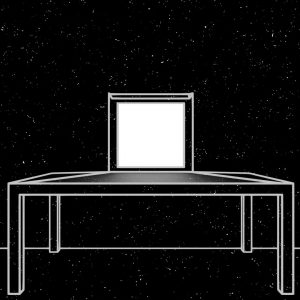
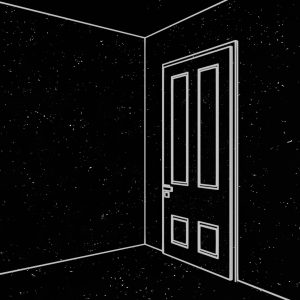
This result, although not exactly special, felt very fitting for the moment. This is still the direction I’m taking, but I don’t ignore the possibility that the general look might change a bit. In any case, this black and white, with heavy focus on outlines, feeling will definitely not change.
I then started working on the models that I will use in the actual project. A door, a desk and a computer (based on the IBM PCjr) are the elements composing the main room.
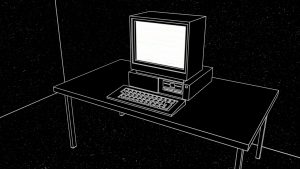
Since it felt a bit hard to explain the projects to professors and peers, I decided to spend some time on a little animation showcasing look, mood and the main mechanic of the game. This has been, so far, one of the best decisions I’ve taken since the beginning of the project. Not only because I could explain the projects with some visible results, but also because seeing the result gave me immense motivation and confirmed my intentions on this project. The animation is very rough (it’s essentially my first ever animation in Blender), but I’d say it does the job.
You can watch it here.
Next steps
In the next weeks I will definitely start working on the implementation of the puzzles. I already have the models I need, and I will model the rooms directly in Unity, since I’m still not sure how the puzzle may be affected by the environment (doing the rooms in Blender might result in a waste of time). I want to choose the easiest, technically speaking, puzzle to implement and start working on it.
I will also have to think about sound and UI. I will probably work on it parallelly since it’s not going to be much (at least for now).
In general, I’d say that it’s about time to make this project functional. Included recreating the shaders in Unity shader graph.
That said,
bye 🙂