
The Quiet Failure of Good Governance
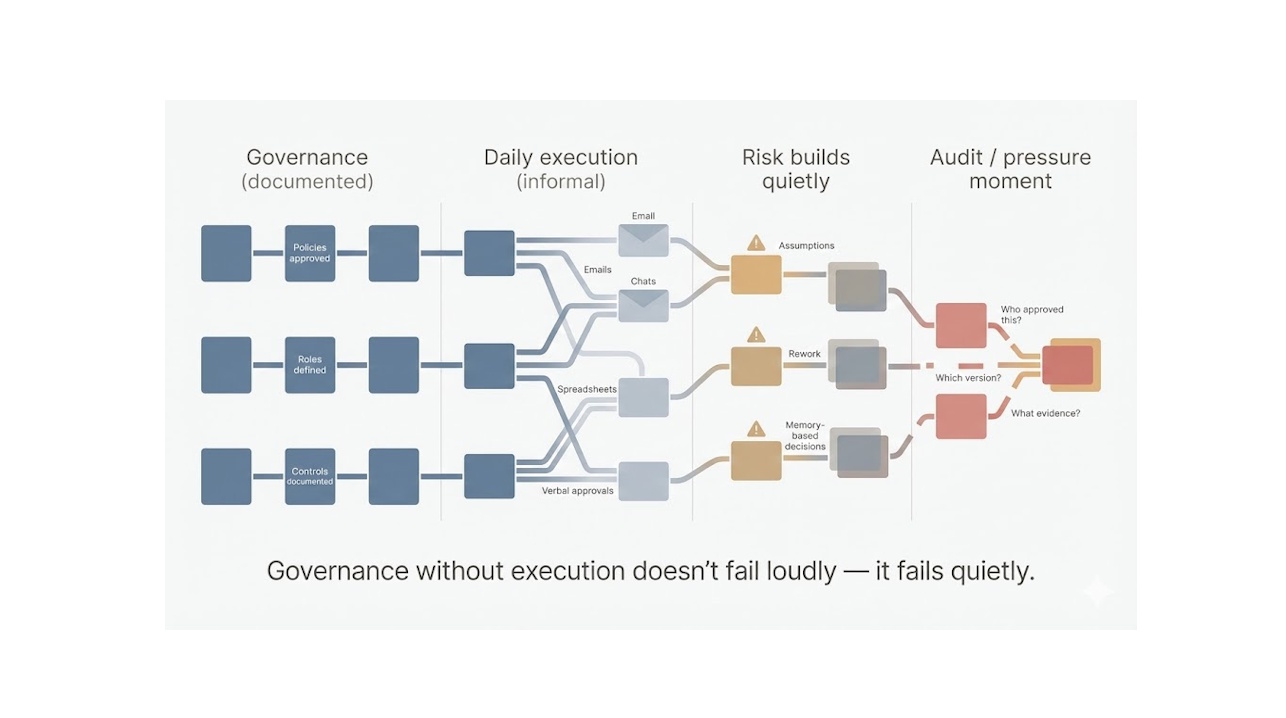
Governance that never reaches execution doesn’t fail loudly.
It fails quietly — through drift, ambiguity, and fatigue.
On paper, everything looks solid: policies approved, responsibilities defined, controls documented.
But in daily operations — especially for Swiss SMEs — work often happens elsewhere.
The Illusion of Control
Many organisations, including Swiss SMEs with their strong tradition of precision and accountability, believe they are well-governed because:
- Policies are formally approved
- Roles are clearly assigned
- Audits are routinely passed
- Systems appear in place
Yet none of these guarantee that rules are followed in practice.
When governance remains in documents while execution relies on email threads or spreadsheets, operations run on assumptions rather than verifiable facts.
This creates an illusion of control — one that holds until pressure reveals the gaps.
What Actually Happens Day to Day
When governance isn’t embedded in workflows, people adapt naturally:
- Approvals happen informally via chat or calls
- Exceptions gradually become the norm
- Decisions are remembered rather than recorded
- Accountability shifts to individuals instead of processes
No one acts in bad faith — they’re simply getting the work done.
Over time, this fosters a quiet acceptance:
“We know how it’s supposed to work — we just don’t work that way.”
The Cost Is Not Visible — Until It Is
Consequences build gradually rather than dramatically:
- Minor disputes escalate unnecessarily
- Audits demand reconstruction rather than simple verification
- Critical knowledge resides with key individuals
- Trust relies on memory instead of evidence
For Swiss SMEs, operating under strict regulatory expectations, this fragility is especially risky. Without the buffers of larger enterprises, small gaps can quickly become significant exposures.
Why More Tools Don’t Fix the Problem
When issues emerge, the common reflex is to add technology:
- Another system
- Another dashboard
- Another reporting layer
But tools alone don’t bridge execution.
Without governed workflows, systems get bypassed, data duplicated, records conflicted, and responsibility blurred.
Technology then adds complexity to an already uncoordinated process.
The Audit Moment Reveals the Truth
Audits — or regulatory reviews common in Switzerland — expose the disconnect unmistakably.
Questions like:
- Who approved this transaction?
- When was this version finalised?
- What verifiable evidence exists?
Often yield answers based on:
- Email trails
- Screenshots
- Verbal accounts
- Reconstructed timelines
At that point, governance shifts from protection to potential liability.
Why Trust Erodes Internally First
Before external stakeholders notice, employees feel the strain.
When teams can’t rely on:
- Shared, tamper-evident records
- Explicit ownership
- Verifiable decision trails
They self-protect by:
- Documenting everything privately
- Avoiding clear responsibility
- Escalating minor issues
This further slows operations and deepens the cycle.
The Quiet Alternative: Making Execution Verifiable
Organisations that succeed don’t pursue grand overhauls.
They begin by identifying one workflow where ambiguity creates real friction — often approvals, versioning, or compliance documentation — and make that process reliable:
- Approvals are recorded and traceable
- Versions are verifiable, not debated
- Responsibilities are embedded directly in the workflow
In select cases, a lightweight blockchain layer anchors key events — preventing retroactive changes without overcomplicating systems.
The impact is understated yet meaningful: fewer debates about “what happened”, more focus on “what happens next.”
Governance Without Execution Is Just Intent
Governance provides direction.
Execution defines reality.
Without verifiable daily practice:
- Governance becomes administrative overhead
- Tools turn into background noise
- Trust remains personal rather than institutional
Swiss SMEs often discover — too late — that having excellent rules is not the same as living them.
The difference lies in operational discipline: turning intent into reliable, everyday practice.
How Parowls Software Supports This Transition
At Parowls Software GmbH, we typically start with a short, focused review of a single real-world workflow — not a system rollout or transformation project. The goal is to identify where governance breaks down in daily execution and design a verifiable, legally aligned path forward without adding unnecessary complexity.
If this gap feels familiar, we’re happy to have a straightforward discussion.

Paul Milner