
Publishing research data contributes to the reproducibility and transparency of research results, supports reuse in future research projects, enhances scientific reputation, and ensures long-term accessibility through publication in subject-specific or institutional repositories such as LORY.
Why should I share my research data?
By sharing your data, you contribute to the reproducibility of research results, increase transparency, and support the scientific community in advancing knowledge.
In addition, more and more funding agencies require compliance with the FAIR principles for handling research data:
- F – indable: Rich metadata, uniquely identifiable
- A – Accessible: Accessible, ideally open (at least metadata)
- I – Interoperable: Use of common standards for data and metadata
- R – Reusable: Explicit licensing for reuse
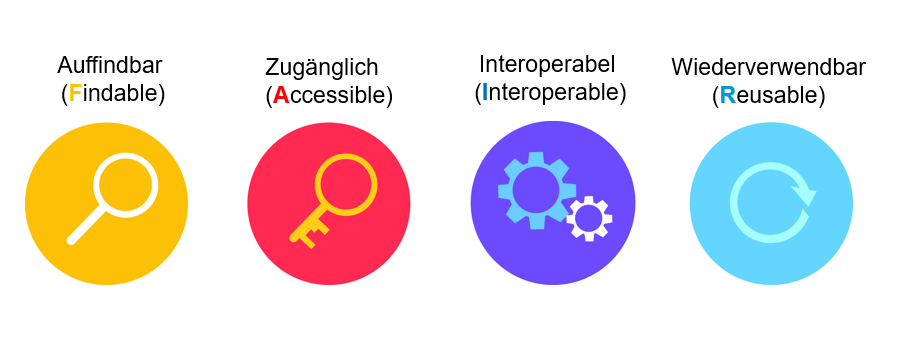
Image source: Paulina Halina Sieminska / forschungsdaten.info
Overview articles and guidance on implementing the FAIR principles:
https://forschungsdaten.info/themen/veroeffentlichen-und-archivieren/faire-daten/
FAIR Data Principles – Force11 (2016)
https://www.force11.org/group/fairgroup/fairprinciples
How can I ensure that others use my data correctly?
You can add metadata to describe your data, define clear terms of use, and apply licenses such as Creative Commons to specify reuse conditions.
Where can I publish my research data?
You can publish your data in subject-specific repositories, institutional databases, or platforms such as LORY or Zenodo, provided they meet the FAIR criteria.
Subject-specific repositories have the advantage of increasing visibility within your research community, though they are less well known to the general public.
List of repositories:
- Swiss institutional and discipline-specific repositories: info/schweiz
- Campus Lucerne: Lucerne Open Repository
- International: Registry of Research Data Repositories: https://www.re3data.org/
What should I consider when choosing a suitable repository?
EA FAIR-compliant repository should meet at least the following criteria:
- Datasets have unique and persistent identifiers (e.g., DOI).
- Extensive and appropriate metadata (well-structured and machine-readable).
- Data are licensed in a way that supports open access (e.g., CC0, CC-BY).
- Long-term access and preservation are ensured.
Which data should I publish?
In general, the following types of data should be published:
- Data underlying a publication
- Unique data
- Data generated with high effort or cost
- Data suitable for reuse
However, note the following:
- Not all data can be made accessible (e.g., data protected by privacy laws, copyright, confidentiality agreements, or patent rights). In such cases, metadata can still be made publicly available, even if the datasets themselves cannot be shared.
- Not all data should or must be preserved permanently (quality management).
How can I ensure that my data remain accessible in the long term?
By using open, non-proprietary formats, you can ensure that your data remain accessible and usable in the future.
It is advisable to store your data in such open formats to ensure better sustainability and compatibility. This guarantees continued accessibility and usability even as technologies evolve.
How can I ensure the reproducibility of my research results?
By sharing complete and well-documented data and providing detailed descriptions of the methods used.
Data Journals
A Data Paper documents and describes research data to facilitate their dissemination and reuse. It provides information about data collection, characteristics, and potential reuse.
Examples:
- Scientific data http://www.nature.com/sdata
- Data in Brief http://www.journals.elsevier.com/data-in-brief
- Data http://www.mdpi.com/journal/data
Overview: https://www.forschungsdaten.org/index.php/Data_Journals
Other forms of documentation:
- README Files
- Data Dictionary
- Codebook
- Electronic laboratory or field notebook