
What opportunities arise when research becomes open and participatory?
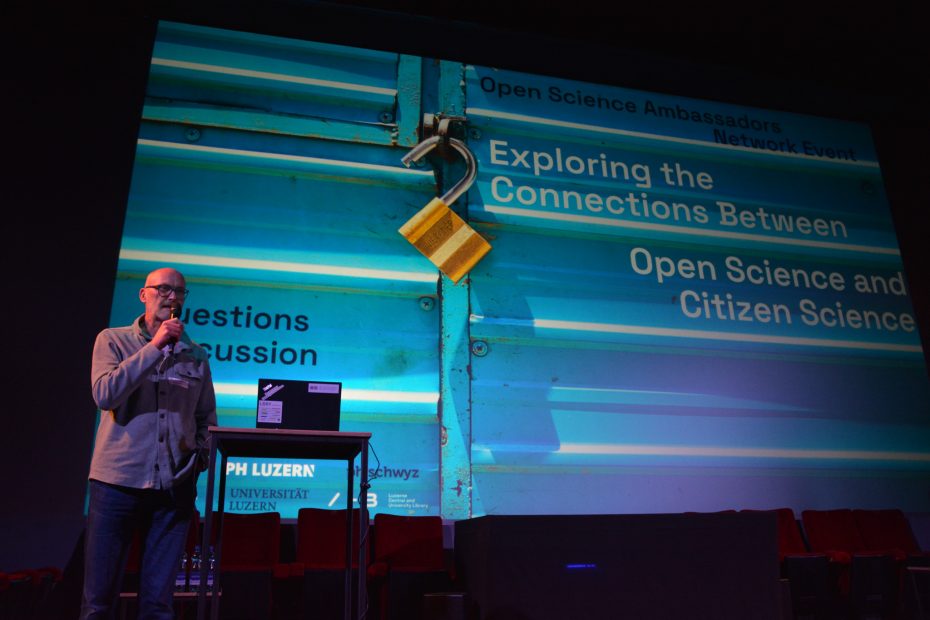
This question was at the heart of the first Open Science Ambassador network event in Central Switzerland. Open science experts and researchers exchanged their experiences on how citizen science and open science can work together to foster a participatory research culture.
The event opened with a keynote by Tizian Zumturm (Schweiz forscht). He provided an overview of different forms and approaches to citizen science, presented current projects, and introduced useful tools – including a comprehensive project guide for developing one’s own initiatives, as well as the “Compass,” a glossary of key terms from the world of research.
Following this, Katharina Roser and Sebastian Stuppan shared insights from their citizen science experiences.
Katharina collaborates with affected individuals to investigate the impact of childhood cancer on their social environment (e-QuoL).
Sebastian has been working for years with student research groups of various educational levels in the geosciences (GLOBE).
The subsequent discussion focused on questions regarding the distinction of roles between citizens as researchers and as research subjects, the global interest in participatory research, and the limits of citizen science in cooperation with industry partners.
Participants included colleagues from the University of Lucerne, Lucerne University of Applied Sciences and Arts, PH Lucerne, PH Zug, PH Schwyz, and the Lucerne Central and University Library (ZHB Luzern).
We are very pleased that so many Open Science Ambassadors took the time and opportunity to exchange ideas, get to know each other, and build connections.
👉 If you would like to learn more about the program, visit the Open Science Ambassador pages of the University of Lucerne or the Lucerne University of Applied Sciences and Arts.