 by
by 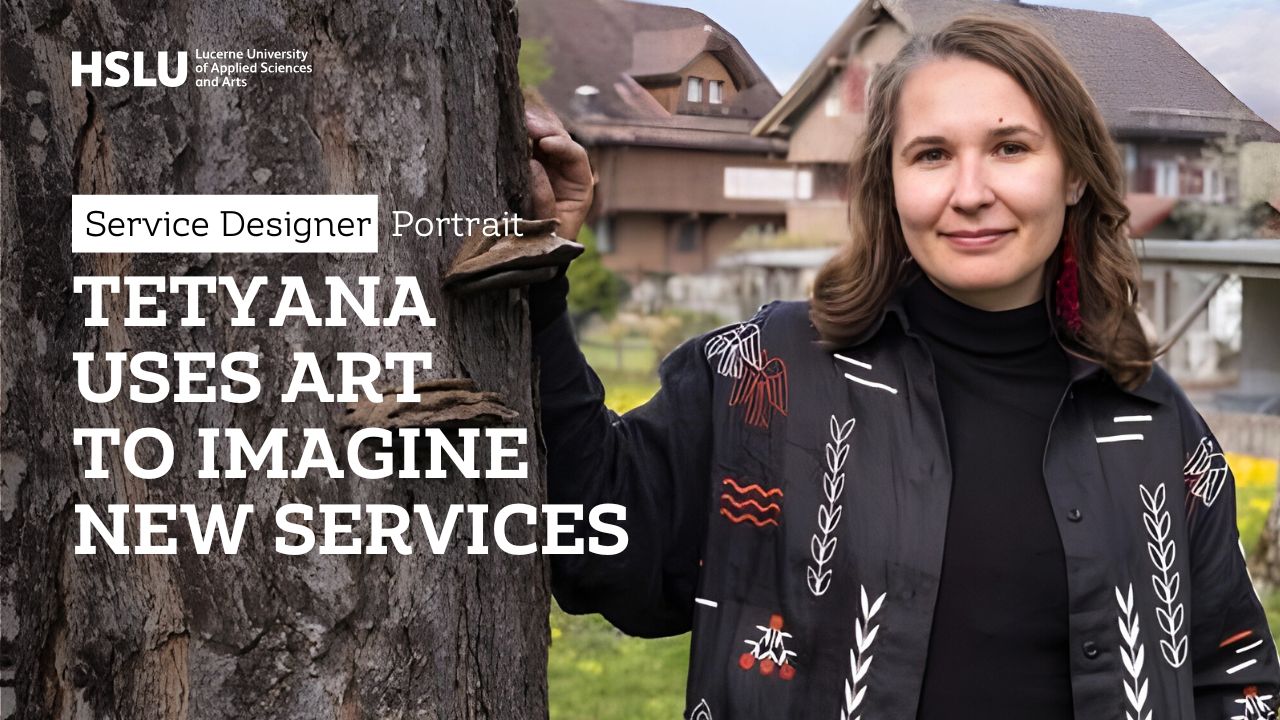
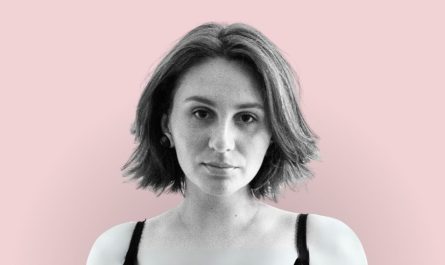
In this interview Tetyana Kalyuzhna shares her personal Service Design journey and how her work explores the intersection of mental health, movement, and landscape as tools for emotional wellbeing.
In this 24 minutes conversation Tetyana covers the following topics:
- Personal Portrait: Get to meet a Service Designer with a background in Fine Art and Book Illustration bringing visual thinking into Service Design.
- Mental Health & Nature: Discover how movement and landscape can be used as a mental gym to bridge therapy sessions.
- Prototyping: See how Tetyana tested her ideas through workshops, exhibitions, and hacking existing services like Vita Parcours.
- Master Experience: Learn about the benefits of a part-time Master’s program and the power of interdisciplinary collaboration.
- Call for Collaboration: Find out how you can participate in Tetyana’s research and experiments.
Meet Tetyana
Connect with Tetyana Kalyuzhna
Discover the Master Service Design program
- Program overview: HSLU Master Service Design
- Ask a question to a student ambassador via a Whatsapp text message: +41 79 572 30 93
Interview highlights
Prefer reading than watching a video? Here are some highlights from the interview that have been shortened and adapted for a smoother reading experience. You can find the full transcript of the interview at the bottom of this article.
How did you discover Service Design?
I have two bachelor’s degrees from Fine Art and Book Illustration and Media. During my working experience, it was always not enough for me to do only book design. I wanted something more, but I didn’t know what I needed.
My field of interest was always graphic design, illustration and psychology. So I was thinking: how to combine it? My bachelor project was about clinical depression and visuals, and I wanted to develop it into something bigger, not only visuals.
I was thinking Service Design is probably something I need. After two months I was desperate—all the vocabulary and other stuff was very new for me and I was a bit lost. But you need time for your brain connections to start to work. After six months, I started to understand what we were talking about.
Now I’m really in love with Service Design and I feel myself in the right place. I realized that all things I did in publishing and graphic design—when I had to build bridges between different departments—was actually Service Design. I just didn’t know the words to name them. Intuitively it has a name and it has different methodology, and now I know how to make these things more effective.
What is your Service Design project about?
What I want to do is to create a bridge in between therapy sessions—like a mental gym. Because we train our body, but mental health and our emotional intelligence is something that also needs to be trained and we don’t pay enough attention to it.
My research is based on two passions. The first is movement and how it influences not only our physical, but mental stability. I made research through different people who have some mental disorders and how they care in a physical way about themselves during their daily life.
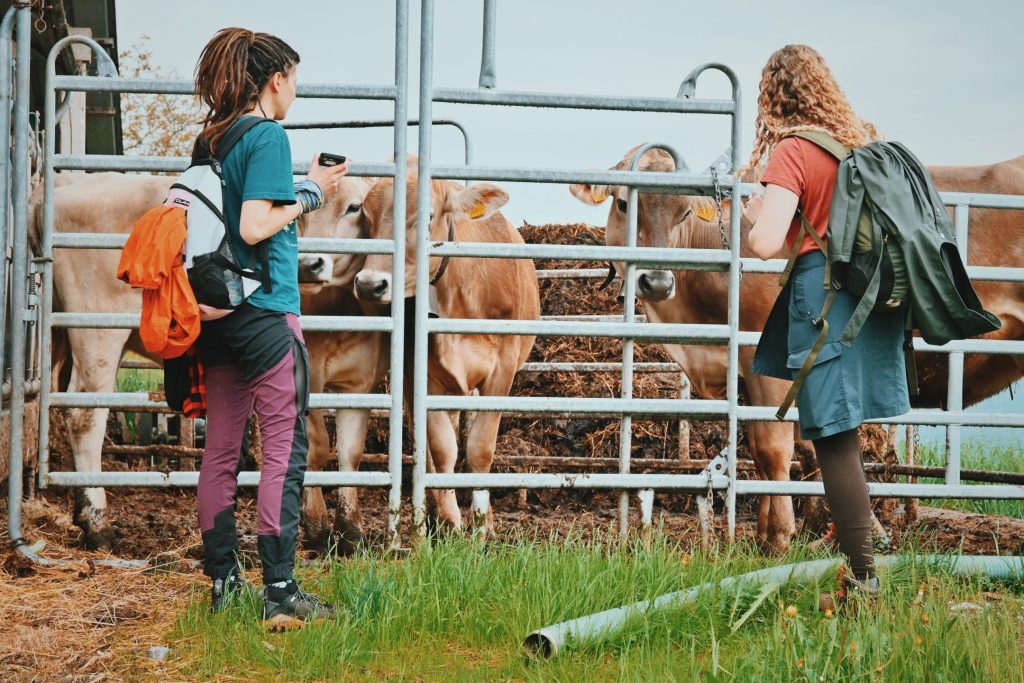
The second pillar is about landscape and how it shapes us physically and mentally. Through informal talks with people in Switzerland and people who moved to Switzerland, I noticed how they make comparisons of landscapes and their habits they had in their daily life in another country.
Somebody from Switzerland said, “If you’re born in central Switzerland, it’s in your DNA—mountains and hiking, it’s what you have to do daily.” I saw mountains for the first time when I was 14 because it’s 800 kilometers from my hometown. My place is totally flat. So my perceiving of a place here is different from somebody who has grown here.
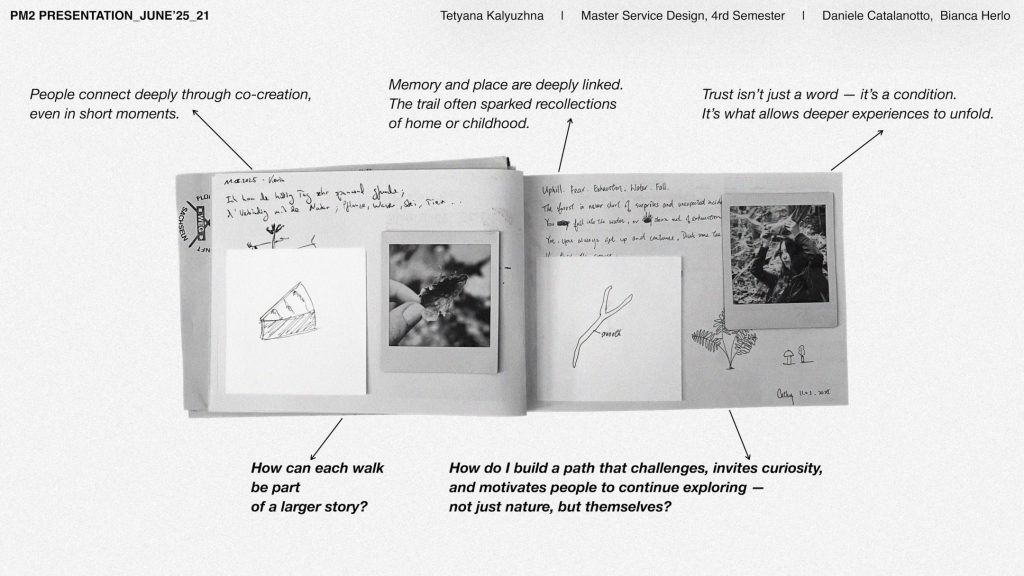
I’m exploring how to use landscape as a community building tool, as a connection, to learn our personal needs and how to use it in daily life to feel better.
How have you been prototyping your ideas?
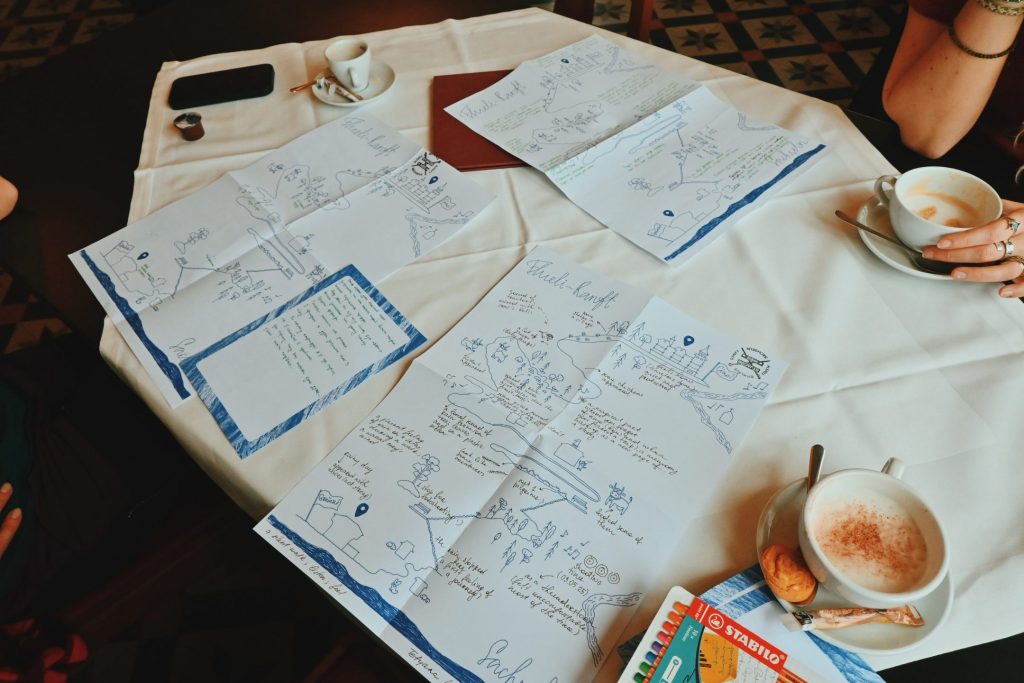
It was important for me to move from reading to practice. I organized three sessions on trails nearby my home and invited my classmates. I was surprised that half of the people who joined were people I didn’t know—friends of friends who just moved and were interested.
I took recommendations from professionals I interviewed before about what to pay attention to and some exercises I could try. I was interested to try different prompts. As an illustrator, drawing a map was the most exciting part for me.
The most precious things I got were through talking. These prompts brought new ideas or born new memories from childhood. We were collecting pieces from a forest and one participant said, “Oh, it reminds me of a toy I was playing with when I was five years old, 30 years ago. I barely forgot about it.” She started storytelling about her joy and it was beautiful.
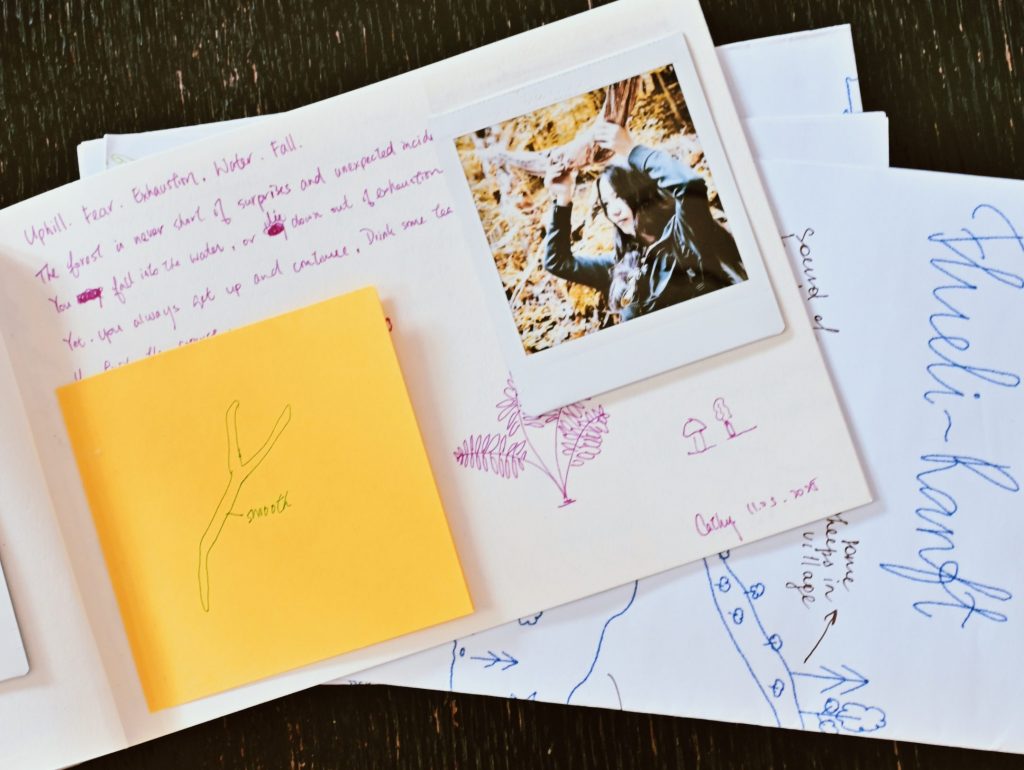
Also, how people become free in the wild. When we are in a city or café, everybody has this role of being somebody in front of somebody. When you are in the wild, in a forest, you just become a kid at some moment. It was nice. I got lots of insights and learnings. I did lots of mistakes for sure, and it was very useful.
What about hacking existing services?
Vita Parcours is a service in Switzerland with 14 physical exercise stations along a trail. Kain during our coaching suggested to me to try to do 14 mental health prompts.
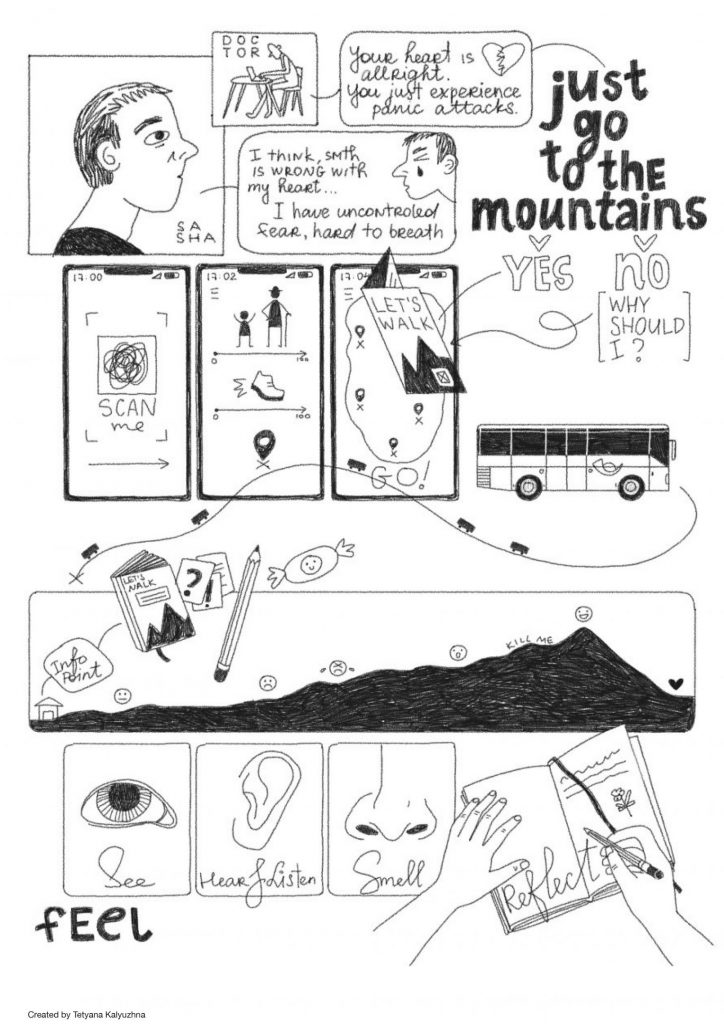
I made beautiful storytelling about how you enter the forest, how you’re greeted, how you open your senses with breathing, watching, touching. But for four hours, I saw no one doing the complete Vita Parcours. People were approaching from different parts—from the end, from the middle.
My storytelling crashed because at the end you had to greet and celebrate the journey, but it made no sense when you started from the celebration. As an illustrator and bookmaker, I always keep storytelling in mind from the first page to the end. That was what I was trying to do, but it didn’t work.
I dropped that idea, but I’m coming back to it again after a year to try something different—maybe with fewer prompts because 14 is too much for mental health, especially for four kilometers. You just start to understand where you are and then the way is ending.
What have you learned about Service Design?
The first thing is that I started to understand clearly what I’m doing. Before it was intuitive—I was feeling that it’s right to go this way. Now I know how it’s called. For example, it’s called a journey map. I understand how to do it more properly, what to pay attention to, what I should keep in mind.
It’s not about creating a product and then making a beautiful journey to it. It’s about the journey and the product at the end could be totally different based on user needs. As an illustrator, this was very new, exciting, and inspiring. When I create a book, I know what I’m going to see at the end. But with services, it’s not about how beautiful it is—it’s about what I find during my research.
What’s special about the HSLU Service Design Master’s program?
As a part-timer, the duration of my master course is six semesters. I think it’s amazing because the first year I was trying to understand what I was doing there—because of lots of new methodology and the language, the scientific language is tricky. I was extremely happy in my second year when everything just connected in my head during the summer.
For a slower thinker as I am, three years was very useful. You have freedom of using different things at school. We have lots of workshops available—textile, clay, 3D, whatever you want. You can connect it with the theoretical part and research part.
The amazing thing is that you are not only in Service Design. You can collaborate with other departments—digital ideation, eco social design, creating something from wood or electronics. You are free to explore whatever you want.
When we have coaching with our colleagues, it’s amazing how much we learn from each other. I have this approach of illustrator and fine art, and then I’m talking to somebody who is from a business world, which is a totally different way of thinking. We exchange all this knowledge and learn from each other.
Who is the Master for and who is it not for?
I think for somebody who would like to be handy and do research at the same time, that’s cool. I understand it’s a big struggle for somebody who is very handy—this research part is tricky and uncomfortable. At least it was for me at the beginning.
Or for somebody who is into research, you have to also change your perspective and become crafty because it’s very helpful. Not only thinking, but also thinking through making.
How can people help you?
I’m trying to be active on LinkedIn. I would like to connect with somebody who is doing something similar to learn from their knowledge and to collaborate.
One prototype I’m testing at the moment is creating seasonal boxes with prompts that I would propose to psychotherapists. This box is like collective knowledge of communities from regions in Switzerland to help explore a place nearby—possibilities of nature through community knowledge, storytelling, and stories.
Maybe somebody who is involved in that or into the term “Erlebniss” I would like to communicate with. I would love to find people who would like to try these boxes with me.
Made with AI help
This blog article is based on the transcription of the recorded video interview and was then turned into a blog post using Notion AI and Claude Sonnet 4.5. The article was then reviewed, corrected and improved by hand by the author.
Video transcript
This transcript was automatically Generated using Descript and therefore contains mistakes and creative turns of phrases.
Teaser
Tetyana: Mental health and our emotional intelligence is something that also need to be trained and we don’t pay enough attention on it.
I have two bachelor’s from Fin Art and Book Illustration and Media.
During my working experience, it was always not enough for me to do like only book design.
My field of interest was always graphic design, illustration and psychology. So I was thinking: how to combine it.
I’m really in love in Service Design and I feel myself on the right place. Intuitively it has a name and it has different methodology, and now I know how to make these things more effective.
What I want to do is to create a bridge in between of therapies. Like a mental gym. When you are into the wild in a forest, you just become a kid at some moment. Not only thinking, but also thinking through making. The amazing thing of this master study is that you are not only in Service Design. You can collaborate with other departments. You are free to explore whatever you want. In digital ideation, in eco social or creating something from wood electronics.
When we have this coaching with our colleagues,
It’s amazing how much we learn from each other.
I have this approach of illustrator and fine art, and then I’m talking to somebody who is from a business world, which is totally different way of thinking.
Introduction and Welcome
Daniele: Welcome everybody to this new session where we interview Service Design professionals and today we are joined with Tetyana. Hello Tetyana!.
Tetyana: Hi Daniele and hi Andy. Thank you for inviting and it’s lovely to see you both finally together. It’s long time.
Daniele: It’s such a pleasure because we are doing these sessions where we do a portrait of a Service Design professional and learner. And today we’re joined with you, Tetyana, and we will explore quite a few things with you. We’ll explore who you are, we’ll explore what is the project that you’re working on, what you have learned around Service Design. And a few more things, but let’s start directly:
Tetyana’s Journey into Design
Daniele: Can you tell us a little bit more about who you are, Tetyana, and how you arrived to Service Design?
Tetyana: At the moment, I’m still exploring who am I? But my background I have two bachelor’s from Fin Art and Book Illustration and Media I did long ago. During my working experience, it was always not enough for me to do like only book design. Like I was shifted from book design to illustration, like to art direction in something from there.
I wanted something more, but I didn’t know what I need. I always thought that design is something connected to a visuals, the graphic design, something like that.
I always wanted to do like a master, because my field of interest was always a graphic design, illustration and psychology So I was thinking how to combine it. And my bachelor project was about a clinical depression and visuals.
And I wanted to develop it into something bigger, not only visuals. So yeah, I was thinking like, Service Design is probably something I, I need. And after two months I was I was desperate. I’m sorry, Andy, but all, all the vocabulary and other stuff was very new for me and I was a bit lost. But now, you know, like you need a time for your brain connections to start to work.
After six months, you started to understand what you were talking about during our core modules. So I’m, I’m, I’m really in love in Service Design at the moment, and I feel myself on the right place.
Daniele: I see this is something that comes quite a lot. This idea that Service Design is a little bit of a bridge between different practices, and in your case
Tetyana: Yes.
Daniele: Of psychology, art, design, and what could be there that connects these different piecesin a kind of coherent, way.
Tetyana: I just regulated that all things I did also in publishing or ingraphic design when I had to build bridges between different departments.
It what I actually liked, you know, this organizational stuff to build in a journey map and other things. I didn’t know the words how to name them, but it was actually what I was doing, and now I understood that what I did. Intuitively it has a name and it has different methodology, and now I know how to make these things more effective.
Andy : Yeah, I think it is a, quite a broad church
Tetyana: Mm-hmm.
Andy : Service Design, and people come into it from lots of different directions and because it does have that slight glue kind of aspect to it. You know, it’s often the stuff in between pulling stuff together. And obviously that’s of ecosystem mindset.
you get people from all walks of life, actually different professions and obviously design professions coming into it.
Exploring Tetyana’s Current Project
Andy : What is your project about? What are you working on at the moment?
Tetyana: Yeah, as I mentioned before. Wanted to follow my passion to psychology after my bachelor. So yeah, I started to dive, what can I do? And as you know, I came from a broad idea to something more smaller and, what I want to do is to create a bridge in between of therapies like a mental gym because we train our body.
But the mental health and our emotional intelligence is something that also need to be trained and we don’t pay enough attention on it. So, my research was based on two things, also two passions I got. Another passion I found in Switzerland is about like hiking and this mountain trails and nature.
So I started to explore first a movement, how it influence on our feelings Not only physical, but mental stability. So I made research through different people who have some mental disorders and how they care like in a physical way about themself during their daily life.
But also because I had, like, there are a lot of research about that, but I would interested to do the personal while through people. I know how it works. And the second pillar is about a landscape how. How it shaped us physically and mentally because through not, not informal talk to people in Switzerland and to people like who moved to Switzerland.
I notice they things, how they, make a lot of comparation of the landscapes and their habits they had in their daily life in another country. And through like my survey when I was asking about this movement in warmup survey about hiking, somebody from Switzerland said like. What is this question about you?
If you’re born in central Switzerland, it’s in your DNA, like mountain and hiking. It’s what you have to do daily. I was like,I saw mountains first time when I was 14 because it’s like. 800 kilometers from my hometown. So my place is totally plain and it’s easy to believe that the world is flat.
So yes, my perceiving of a place even here, how I deal with daily circumstances is different from somebody who has grown here. And it’s usual to go like two kilometers down from a mountain to do a grocery. For me, it’s a big thing to do. I made a research on that and how to use a landscape also as a community building.
As a connection, as a tool to learn ourself, our personal needs and how to use it into a daily life to feel better.
Andy : And how have you been sort of wrapping this up in the service aspect of it?
Tetyana: I’m trying to make this bridge in between a session therapies so I’m trying to find a service or to find more practical tool, how to do it, how to propose, and from whom it would be proposed, the sessions.
Because when it’s going about mental health, it’s about trust and fairs and other aspects. .
Andy : So you are sort of constructing more of like a kind of framework and a structure for, it’s not just going for a walk in the mountains, right?
Tetyana: Yes,
Andy : structure to it that, and that’s the bit that you are working on and designing.
Tetyana: yes. I’m trying to find out different like tools and services, which would be, presented to a user because it’s not just like, as you mentioned, walking in the mountains. could be something on the way of how to make trust, to bring interest, to follow it, and to continue doing exercises.
So I’m exploring also this part of surprising which would bring my user interest to go outside from this comfortable box being made for ourself.
Prototyping and Practical Applications
Daniele: I know that you’ve made quite a few prototypes already. from what I remember, you’ve done work around workshops. You’ve done work around a subscription box. You’ve made also exhibitions and pieces around that. Can you tell us a little bit how you prototyped these many service ideas and directions that you have developed for your project?
Tetyana: Yes, it was important for me to move from reading to practice because I read a lot of books from nature therapy and nature Coaching. And it was all exciting and interesting, but I was excited how it works in real life to feel, how is it to be a coach? So I don’t have this education, but, I talked to people who were doing it and I was interested to feel it? So I organized three sessions on the way I know on trails nearby my home. And I invited my classmates. So it’s easier while you study, you have access to many people. But I was surprised that half ofpeople who joinedsomebody I actually didn’t know.
So just somebody from my classmates, I couldn’t go, but they say, oh, I have a friend who just moved who would be interested. Don’t you mind to grab and entertain. So I was like, okay, let’s try. So I was surprised about that aspect that people didn’t know me and they were ready to go with me somewhere in a vault into the mountains to do.
They didn’t know what.
I took some recommendations from professionals. I interviewed before what to pay attention and some exercises I could try.
I was interested to try different prompts like draw in a, a map as I’m illustrator. It was, the most exciting part for me.
Yes. And to see how participants interact with it. And you know, the most precious things I got is through talking. So like how this prompts broughtnew ideas or born new memories from childhood or things They forgot about, like we were collecting some pieces from a forest and one of the participants she said like, oh, it reminds me a toy I was playing when I was three, or like, it was five years old.
And it was like 30 years ago. I barely forgot about it. And she started, continue the storytelling about her joy and it was beautiful also, How people become free into the wild. So when we are in a city, on a cafe, everybody has this role of being somebody in front of somebody. And when you are into the wild in a forest, you just become a kid at some moment.
So it was, it was nice. I got a lot of insightsand learnings. I did lots of mistakes for sure. And, it was very useful. And the piece I did in the museum, it was a different approach, like a fine art approach. So every time I’m doing something, I’m doing something around the object.
So I’m creating illustration or in the museum created this piece of like mushroom from clay with a ear underneath. So it was like a metaphor of the nature that it can listen to us and it’s a, a living object. So, it was a different approach as I mentioned, from a fine art. And I just observed how people handled the tree.
They were like curious seeing mushrooms and it worked perfectly with adults. So because it was easier to communicate with adults with this metaphors and prompts, but with kids, it was very funny because some of them, they never saw, like never paid attention and mushrooms on the trees.
so it was a different communication with them. But my project is probably more to adults or to somebody who is open to this abstract thinking.
Daniele: It’s been very impressive to follow your work, especially because you have this big strengths in going from an abstract thought into making it very tangible. And one of the things that I found that you’ve made brilliantly was also how you hacked existing services to try out new services. Can you tell us a little bit more about. What you did with this thing, which is called Parcours Vita in Switzerland, maybe explain what is this park Vita thing and how you used it as a way to Prototype your own service ideas.
Tetyana: Yes, it was my first try. Vita Parcours is a service in Switzerland in different cantons and different trails. There are 14 prompts with physical exercises with three different difficulties. Depends how trained you are. So it’s available, it’s free, and basically you can find it on a map and to join from one to 14 like four kilometers way like training thing.
And I think Karin during our coaching, she suggested to me to try to do this 14 mental health problems. so I went to Schaffhausen and to visit my friend. And I made some beautiful storytelling about how you enter forest, how you greeted, how you open your like senses with braising, with watching, with touching.
And then for four hours, I basically saw no one doing Vita Parcours. And there was funny thing, I saw people approaching from like different parts from the end, from like a middle. So my storytelling crushed because like at the end you had to greet and to like, you know, to wrap it all, to celebrate all this journey.
But it made no sense when you started from the celebration to the end when you start to greet the forest. So it was a new learning that the storytelling should be totally different because as, as an illustrator, like a bookmaker, I keep it always in my mind, this all storytelling from the first page, how it goes, like to the middle of the book.
and that was what I was trying to do but yes, it didn’t work. So I dropped that idea, but I’m coming back to it again after a year. to try something different. it could be like a new Prototype I would like to make, but not with 14 prompts because it’s too much for mental health, especially for four kilometers.
I mean, you just start to understand where you are and then the way it’s ending. And there are a lot of things you have to do. So I would like, to repeat this Prototype, but with less prompt and maybe a bit different approach to see how it works.
Daniele: It is brilliant to see how much you learn in the process. You say a lot I’ve made this mistake, then I adjusted it like that.
Insights and Learnings in Service Design
Daniele: What are some of the key lessons and insights about Service Design you’ve learned and that changed your perspective?
Tetyana: Yeah, the first thing I mentioned that I started to understand clear what I’m doing because before it was intuitively so I was feeling that, oh, it’s right to go this way, but. Now I know how it called, for example, it’s called a journey map. So I understand how to do it at least more properly.
Like what to pay attention on. what should I keep in mind? Yes, I think it became very helpful for me to understand what I should keep in mind and what I should pay attention on during the whole process of service. So it’s not about creating a product and then to make a beautiful journey to it. It is about the journey and the product at the end could be totally different.
So based on user needs. So for me, as we illustrated, it was very new thing, very Inspiring and exciting because if I create a book, I know what I gonna see at the end. and my audience will find me. But when it’s going about the services and to construct something, it’s not about how beautiful it is.
It’s about what I find during my research,
Andy : It’s interesting hearing you
Tetyana: I.
Andy : Relate that journey from kind of learning the method, if you like. Well, it maybe, you know, having read something or learning the method to actually doing it. And I often think with this it is like a you know, if I was a carpenter, I could teach you how to use a chisel. But the art of carpentry and the wood grain and knowing when something’s finished or it’s like, I dunno, baking too or something, you
Tetyana: Mm.
Andy : You can have the recipe, but there’s a lot of like, oh, the dough’s not quite there yet. Feel how sticky it is under your finger. This is the thing to look out for when it looks, this texture and those kinds of things. I think only really come through through doing.
Tetyana: I actually, I learned from you, like when I came to you during the coach and I say, oh, I want to make a game, and you’re like, okay, what is fr? Like, why do I need a game? I’m explaining why is it your ending product? And every time it made me frustrated, but I, I like how my way of thinking changed it.
It helps me a lot. Even during the daily life.
Andy : I’m glad to hear I wasn’t just annoying.
Master’s Program Experience
Andy : I mean, part of the thing is, and this should lead me onto the next question about the masters, is you have a unique couple of years, right, to go deep into something you really want to go into. You don’t really have someone else telling you what you have to do, and you know you have deadlines, but there isn’t nearly the kind of time pressure that there is in the commercial world.
But there’s also a safe space, right, where you can try things out and mess up and there’s no one going well. Yeah, you are fired now. I mean, it is a really nice environment for that. And obviously we can then be a little bit more annoying and say, well, why is, what’s the, what’s the point of that?
What are you trying to do with this? and less directive than you might get when you’re actually kind of working. So, you know, on that, Who do you think a master like this is for and who is it not for?
Tetyana: I’m a part-timer. So the duration of my master course is six semester. I think it’s amazing for me at least, because the first year I was trying to understand what I was doing there because of a lot of new methodology and the language, the scientific language is also tricky when I translate it all into Ukraine, sometimes I need 30 minutes to understand what I just read and I was extremely happy on my second year when everything just connected in my head during the summer and I clearly saw where I have to move and what I have to do. So, I mean, for probably slower thinker as I am, it was very useful three years. and you have this freedom of using different things at school.
Like as I said, I’m doing my, prototypes and my research by creating prompts. And it’s amazing that we have a lot of workshops at school available for us to do, like textile or something from Clay 3D, whatever you want. and you can connect it with a theoretical part research part. So I think for somebody who would like to be handy and research.
At the same time. That’s cool. And I understand it’s a big for somebody who is veryhandy. This part who used to do to create stuff. This research part is tricky and uncomfortable. At least it was for me at the beginning. Or for somebody who is in research, you have to also change your perspective and become crafty because it’s very helpful.
Not only thinking, but also thinking through making. A lot of people already said it. The amazing thing of this master study is that you are not only in Service Design, you can collaborate with other departments. So we have our core module one week, but during the other four days, You are free to explore whatever you want in a digital ideation department, like in eco social or creating something from wood electronics.
So I think that’s amazing thing.
Andy : Amazing. Yeah, it is. Daniele and I had to join the tour around the workshops the other day ’cause I hadn’t seen it so much in the new building. Andyou’re very spoiled. You’ve got a lot available to you. It’s, it’s pretty amazing. But also, as you say, there’s all the other, our colleagues who have, a lot of skills that obviously are appropriate to their masters that they lead and stuff, but also lots of other background. It’s really interesting. I always find when everyone introduces themselves and as sort of someone who would think, they’re working in that area and like an admin area and that, and they’re like Julia and it’s got real skills in 3D printing and stuff like that. And so it’s very rich.
I appreciatethe place, the space, the students and the colleagues.
Tetyana: Yeah. I think I would add one more thing, like we talked about it during our colloquium last time. When we have this coaching with our colleagues, it’s amazing also how much we learn from each other because as I mentioned, like I have this approach of illustrator and fine art, and then I’m talking to somebody who is from a business world, which is totally different way of thinking. And then I have this new insights, oh, it’s like I could go also this way and how we exchange all this knowledge and how we learn.
Call for Collaboration and Conclusion
Daniele: You are at a very interesting stage in your project where you’re looking for people to help you out maybe for partners. How can people who are listening to this help you out?
Tetyana: First I’m trying to be active on Linkedin, I’m trying to post when I need help in participating some of my workshops. I would like probably to connect to somebody who is doing something also similar to learn from their knowledge and to collaborate.
One more Prototype I’m trying to test at the moment is to create the seasonal boxes with prompts. I would propose a psychotherapy. So I would like to find some people who would like to try them with me. and this box is like a collective knowledge of communities ofsome regions in Switzerland.
to help to explore a place nearby like possibilities of nature through community and storytelling and stories. So maybe somebody who is involved that or into the in terms “Erlebniss”. I would like to communicate to.
Daniele: I’m sure that there are people who might be very interested to try out your experiments. And I’m sure that there are some professionals who might be very
Tetyana: Hmm.
Daniele: People that to collaborate with.
And so please knock on Tetyana’s LinkedIn door or website, and I’m sure there will be lovely ways for participating and collaborating.
Andy : And we can find you on Instagram too, right?
Tetyana: Yes.
Andy : I keep seeing lovely pictures of you sort of on the top of mountains and then beautiful sketches, beautiful illustrations, so.
Tetyana: Thank you. they’re a bit more than a Linkedin, because it would be weird to post a Linkedin, Hey guys, I hiked recently in
Andy : right,
Tetyana: somewhere in grind, I guess. but there are also some insights I have every time from hiking, yes, from hikes.
Daniele: So thank you so much Tetyana and Andy for this lovely conversation. I think we learned a lot about how we can integrate also art and psychology within Service Design. It’s been brilliant to see all your prototypes and your reflections about all these: learnings, failures, positive moments. And so on my side, a big thank you to you, Tetyana, for joining us today for sharing all your knowledge. And obviously a big thank you also to you, Andy, for all the smart questions. As always,
Andy : Pleasure. Thank you, Tetyana.
Tetyana: Thank you.
Daniele: I have a lovely week. Cheers. Bye.